How Did the Tie Become Cool Again?
One British shirt retailer says its tie sales jumped by 200% this summer, and some writers think young people are leading a return to smarter clothes. The figure comes from one company, so it is a clue, not proof.
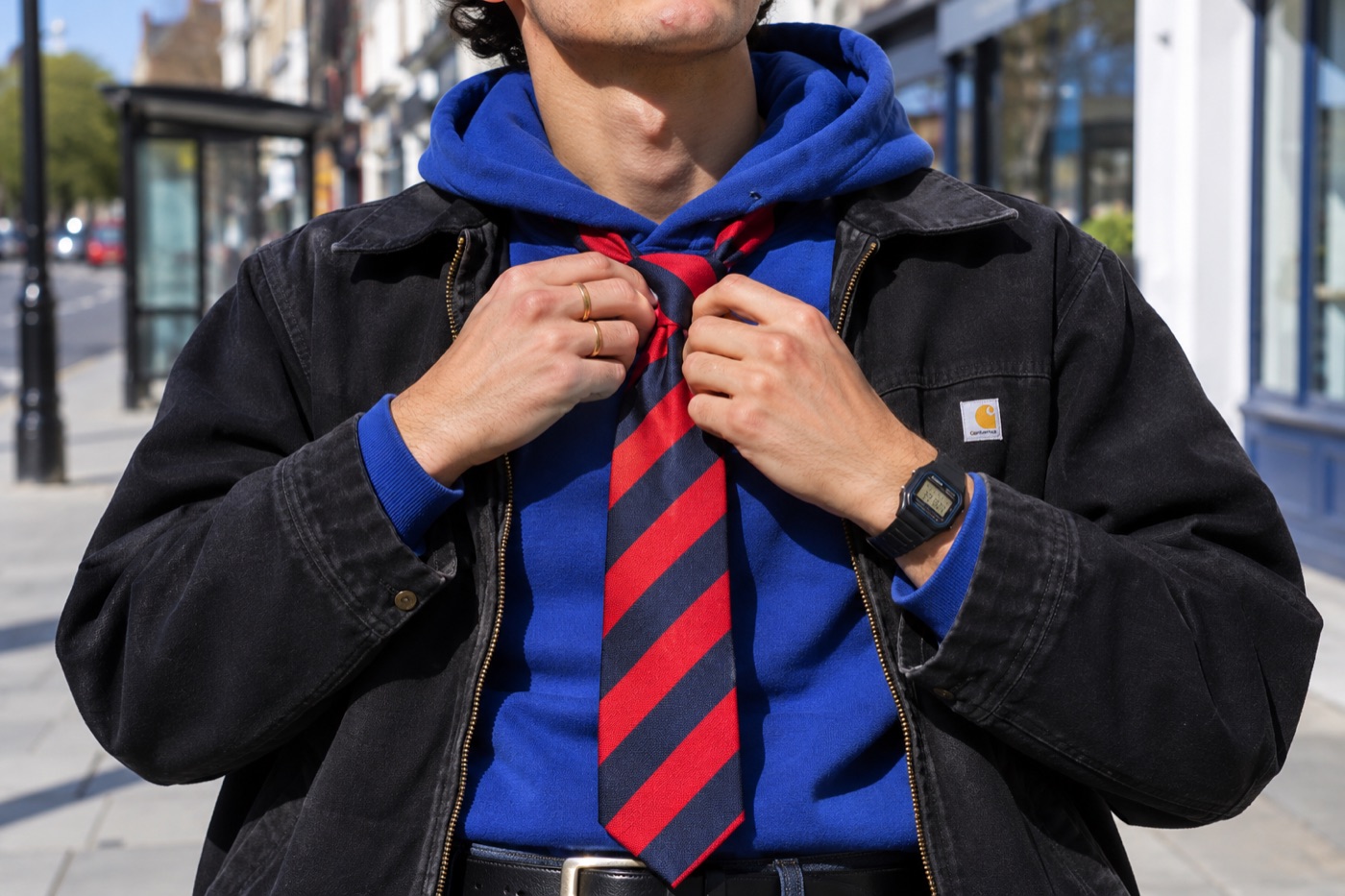
Warm up3 questions
- When do people wear ties where you live?
- Do you like to dress up, or do you prefer comfortable clothes?
- Do you think fashion comes back after a few years?
Sentence help (optional): I'd choose ... because ... · For me, ... · I think ... because ...
Warm up3 questions
- When do people wear ties where you live?
- Do you like to dress up, or do you prefer comfortable clothes?
- Do you think fashion comes back after a few years?
Warm up3 questions
- When do people wear ties where you live?
- Do you like to dress up, or do you prefer comfortable clothes?
- Do you think fashion comes back after a few years?
Core version
What do you think of when you see a tie? For many people, it is something old-fashioned, perhaps part of a school uniform or a boring office job. But in October 2026, a British newspaper asked a surprising question: are ties becoming cool again?
Ties almost disappeared in the last few years. The Guardian says two things helped to push them out. One was a style in which men wore suits with open shirts and no tie. The other was the time of Covid, when many people worked from home and did not need to dress up.
Now there are signs of a change. A British company called TM Lewin says that its tie sales went up by 200% this summer, compared with the summer before. That sounds huge, but be careful. It is only one company, and it did not say how many ties it sold. The company also closed its shops in the pandemic and is now opening some again, so the starting point may have been low.
Why might young people like ties? The Guardian gives one idea. It says the open-collar look is now linked with older bosses, and some young people do not want to dress like their boss, so they dress up. This is only one explanation, not proven fact. The head of TM Lewin said that men are dressing smarter for work and for weddings. He joked that the tie has died about ten times and always comes back.
The story is not the same everywhere. Weeks before, the House of Lords, part of the British parliament, changed its rules so that men no longer have to wear a tie in the chamber. In some places, the tie is on its way out. In others, it is a blast from the past that is returning.
Ties have a long history. They began with cravats, a kind of scarf worn by soldiers from Croatia who served in France in the 1600s. A New York tailor patented the modern tie in the early 1920s, and the shapes and knots have changed many times since then. Fashion often seems to come full circle. Do you think ties are cool, or are they only a uniform?
Intermediate version
Think about a tie. For many people, it belongs to school uniforms, weddings and offices where everyone is a little bored. But in October 2026 the Guardian reported that one British retailer is selling far more of them, and it asked whether young people are bringing the tie back.
First, why did ties nearly disappear? The Guardian points to two causes. One was a fashion in which men wore suits with open-collar shirts and no tie. The other was the Covid period, when many people worked from home and had no reason to dress up. Together, they pushed the necktie close to extinction.
Now for the numbers. The shirt company TM Lewin says that its tie sales rose by 200% year on year this summer. It is a striking figure, but it needs care. It comes from one retailer, not from the whole clothing industry, and the company did not say how many ties it actually sold. TM Lewin also closed its shops during the pandemic and has been reopening some, so its sales may have been growing from a low starting point. Its managing director, Dan Ferris, told The Times that men are dressing smarter for work and for weddings, and he joked that the tie has died about ten times and keeps coming back. He also said that customers who come in for a suit often add a tie.
Why might young people be involved? The Guardian offers one idea. In its view, the informal open-collar look is now linked with older, well-off bosses, and young people do not want to dress like the boss, so they dress up. That is the newspaper's explanation. It is not something that the sales figure proves, and the article is written as a light, humorous column.
Fashion rarely moves in one direction. Only weeks before, the House of Lords changed its rules so that men no longer have to wear a tie in the chamber. For some people the tie is a sign of the times that is fading, and for others it is a blast from the past that is coming back.
The tie also has a long history. It began with cravats, worn by soldiers from Croatia who served in France during the Thirty Years' War in the 1600s. A New York tailor, Jesse Langsdorf, patented the modern necktie in the early 1920s, and the fashionable knots, widths and patterns have changed again and again. The four-in-hand knot was popular in Victorian times, for example, and the windsor came later, between the world wars. That may be why fashion often seems to come full circle.
So are ties really cool again, or has one company found a clever way to describe a good summer? What would make you choose to wear a tie when nobody makes you?
Advanced version
For years the necktie looked like a fashion on its way out. The Guardian says two forces nearly finished it: the habit of wearing a suit with an open-collar shirt, and the shift to working from home during Covid. In October 2026, however, the paper ran a column asking whether ties are returning, and whether Generation Z is responsible.
The evidence is a single sales figure. The menswear retailer TM Lewin says that year-on-year sales of ties rose by 200% this summer. That deserves attention, but it deserves caution as well. It comes from one company, not from the whole clothing industry, and the coverage gives no absolute numbers, so the rise could be from a small base. The retailer also closed all its shops in the pandemic and has been rebuilding: according to a trade report, it plans seven stores after two openings in November, compared with about 150 at its peak in the mid-2010s. A business that is growing again would be expected to sell more of everything.
The company's managing director, Dan Ferris, told The Times that men are dressing smarter for work and for events such as weddings, and joked that the tie has died about ten times and keeps coming back. He added that ties are often an extra purchase for customers who come in to look at suits. This is a seller describing its own customers, which is useful testimony but not neutral research.
The Guardian's explanation for the youth link is a generational backlash. In its view, the informal look is now the habit of well-off, middle-aged men, and young people, who do not want to resemble the boss, dress up instead. It is an appealing theory, and it fits a familiar pattern in which each generation defines itself against the one before. But it is the columnist's interpretation, and the sales figure does not tell us the age of any buyer. The piece also says, more lightly, that young people may be choosing leather shoes over trainers, without figures to support it.
Meanwhile the evidence points in more than one direction. Only weeks before the column, the House of Lords relaxed its rules so that men no longer have to wear a tie in the chamber. The tie may be a sign of the times in one place and a blast from the past in another, and the two stories do not contradict each other if you allow that fashion moves unevenly.
Its history supports that cautious view. The tie grew out of the cravat, worn by Croatian soldiers who served in France during the Thirty Years' War in the 1600s, and the modern necktie was patented by a New York tailor, Jesse Langsdorf, in the early 1920s. Since then, lengths, widths and knots have been in constant motion: the four-in-hand knot was popular in Victorian times, the windsor arrived between the world wars, and the half-windsor followed in the 1950s. What looks like a revival may simply be fashion coming full circle, as it has before.
Study this story
Save the words you want to keep, talk about the story, then practise the language.
Highlights0 saved
Highlights0 saved
Highlights0 saved
Talk about it3 questions
- Why should we be careful about a sales figure from only one company?
- Would you wear a tie if nobody made you? Why, or why not?
- Do young people want to look different from older people? How?
Sentence help (optional): I think ... because ... · One reason is ... · For me, ...
You can talk about people in general instead of yourself, and you can pass on any question.
Talk about it3 questions
- Why should we be careful about a sales figure from only one company?
- Would you wear a tie if nobody made you? Why, or why not?
- Do young people want to look different from older people? How?
You can talk about people in general instead of yourself, and you can pass on any question.
Try it
Work in a pair or a small group. Choose one item that people once thought was out of date, such as a type of shoe, a hairstyle or a hat, and invent a short story about how it became popular again. Decide who started the trend, what changed and why people liked it. Then name one fact you would need before you could say that the trend was real. Nobody needs to wear anything, take photos or share personal details.
Exercises4 exercises
1. Complete the sentences
Drag a word into each gap, or tap a word and then tap a gap. Tap a filled gap to put the word back. Two words are not needed.
- TM Lewin says its tie sales went up by 200% this .
- It is only one , and it did not say how many ties it sold.
- Ties began with cravats, a kind of worn by soldiers from Croatia.
- Weeks before, the House of changed its rules about ties.
- A New York patented the modern tie in the early 1920s.
2. Match the meaning
Choose the meaning of each word or phrase as it is used in the article.
- old-fashioned
- pandemic
- explanation
- tailor
Write the letter of the meaning next to each word.
- A not modern, like something from the past
- B a person who makes clothes
- C a reason that tells why something happens
- D a time when a disease spreads across the world
3. Put the verb in the right form
Write the correct form of the verb in brackets.
- TM Lewin's tie sales up by 200% this summer. (go)
- Many people from home during Covid. (work)
- The company its shops in the pandemic. (close)
- The head of TM Lewin that the tie has died about ten times. (joke)
- A New York tailor the modern tie in the early 1920s. (patent)
4. True, false or not given
Choose Not given if the article does not say, even when you think the statement is probably true.
- The 200% figure comes from one company.
The text says: "It is only one company"
- TM Lewin said exactly how many ties it sold.
The text says: "it did not say how many ties it sold"
- TM Lewin was started in the year 1898.
The text does not give this information.
- The House of Lords changed its rules about wearing ties.
The text says: "changed its rules so that men no longer have to wear a tie in the chamber"
- The modern tie was patented in the 1800s.
The text says: "A New York tailor patented the modern tie in the early 1920s"
Your score
Do all four, then add them up.
Answer key
- Complete the sentences1 summer · 2 company · 3 scarf · 4 Lords · 5 tailor
- Match the meaning1 old-fashioned = A · 2 pandemic = D · 3 explanation = C · 4 tailor = B
- Put the verb in the right form1 went · 2 worked · 3 closed · 4 joked · 5 patented
- True, false or not given1 True · 2 False · 3 Not given · 4 True · 5 False
1. Complete the sentences
Drag a word into each gap, or tap a word and then tap a gap. Tap a filled gap to put the word back. Two words are not needed.
- TM Lewin says its tie sales rose by 200% year on this summer.
- The figure comes from one , not from the whole clothing industry.
- The company did not say how many ties it actually .
- The managing director said that men are dressing for work and for weddings.
- Customers who come in for a suit often a tie.
- The modern necktie was patented by a New York , Jesse Langsdorf.
2. Match the meaning
Choose the meaning of each word or phrase as it is used in the article.
- extinction
- retailer
- informal
- patented
Write the letter of the meaning next to each word.
- A relaxed, not formal
- B the state of having completely disappeared
- C officially registered an invention so that others cannot copy it
- D a business that sells things to the public
3. Put the verb in the right form
Write the correct form of the verb in brackets.
- TM Lewin its shops during the pandemic. (close)
- Its sales may have growing from a low starting point. (be)
- Dan Ferris that the tie has died about ten times. (joke)
- A New York tailor the modern necktie in the early 1920s. (patent)
- The Guardian to two causes. (point)
4. True, false or not given
Choose Not given if the article does not say, even when you think the statement is probably true.
- The 200% figure comes from one retailer.
The text says: "It comes from one retailer, not from the whole clothing industry"
- The Guardian article is a serious scientific study.
The text says: "the article is written as a light, humorous column"
- Dan Ferris is fifty years old.
The text does not give this information.
- Customers who buy a suit often add a tie.
The text says: "customers who come in for a suit often add a tie"
- The windsor knot came before the four-in-hand knot.
The text says: "the windsor came later, between the world wars"
Your score
Do all four, then add them up.
Answer key
- Complete the sentences1 year · 2 retailer · 3 sold · 4 smarter · 5 add · 6 tailor
- Match the meaning1 extinction = B · 2 retailer = D · 3 informal = A · 4 patented = C
- Put the verb in the right form1 closed · 2 been · 3 joked · 4 patented · 5 points
- True, false or not given1 True · 2 False · 3 Not given · 4 True · 5 False
1. Complete the sentences
Drag a word into each gap, or tap a word and then tap a gap. Tap a filled gap to put the word back. Two words are not needed.
- The Guardian says working from during Covid helped to finish off the tie.
- The coverage gives no numbers, so the rise could be from a small base.
- A seller is describing its own .
- The youth explanation is an appealing .
- The sales figure does not tell us the of any buyer.
- The tie grew out of the , worn by Croatian soldiers.
2. Match the meaning
Choose the meaning of each word or phrase as it is used in the article.
- backlash
- testimony
- revival
- contradict
Write the letter of the meaning next to each word.
- A a time when something old becomes popular again
- B to say or show the opposite of something
- C a strong reaction against something that came before
- D a statement from someone about what they know or have seen
3. Make the right word
Use the word in brackets to make a word that fits the gap.
- It is an theory, and it fits a familiar pattern. (APPEAL)
- The Guardian's explanation for the youth link is a backlash. (GENERATION)
- Fashion moves . (EVEN)
- Its history supports that view. (CAUTION)
- What looks like a may simply be fashion coming full circle. (REVIVE)
4. True, false or not given
Choose Not given if the article does not say, even when you think the statement is probably true.
- The sales figure does not show the age of any buyer.
The text says: "the sales figure does not tell us the age of any buyer"
- The 200% figure comes from the whole clothing industry.
The text says: "It comes from one company, not from the whole clothing industry"
- The text names the owner of TM Lewin.
The text does not give this information.
- The retailer plans seven stores after two openings in November.
The text says: "it plans seven stores after two openings in November"
- The modern necktie was patented in the 1800s.
The text says: "the modern necktie was patented by a New York tailor, Jesse Langsdorf, in the early 1920s"
Your score
Do all four, then add them up.
Answer key
- Complete the sentences1 home · 2 absolute · 3 customers · 4 theory · 5 age · 6 cravat
- Match the meaning1 backlash = C · 2 testimony = D · 3 revival = A · 4 contradict = B
- Make the right word1 appealing · 2 generational · 3 unevenly · 4 cautious · 5 revival
- True, false or not given1 True · 2 False · 3 Not given · 4 True · 5 False
Continue reading
Music & style
Why a Great Song Doesn't Need Your Language
Songs in 16 languages reached a streaming service's global top 50 in 2025. What makes a song travel, and what gets lost on the way?
Music & style
Would You Wear a Rival Team's Shirt?
A writer argues that fashion has discovered the football shirt. So what are you saying when you wear one, and who decides what it means?
Music & style
What Makes a Bad Photo a Good Memory?
Some people are going back to older digital cameras. What can a blurry photo give you that a perfect one can't?


Read this article online: johnplusnews.com/articles/how-did-the-tie-become-cool-again/