News lesson12 October 2026
Can Art Bring New Life to a Crumbling Village?
A footbridge, a famous view and a crumbling cliff. Civita draws visitors all summer, but keeping people there through the winter is the harder problem.
Before you read
1Warm up3 questions
Talk about these questions with a partner.
- Would you live in a beautiful village with very few neighbours?
- What makes a place feel alive beyond having visitors?
- Can an arts event change how people see a town?
2Key words8 words
These words are in the article. Choose the letter of the meaning for each one.
- valley
- permanently
- community
- contemporary
- joint
- exhibitions
- guesthouses
- organisers
- Ashared by two or more people or groups
- Bsmall, cheap hotels
- Clow land between two hills or mountains
- Dpublic shows of art or other things
- Eof the present time, modern
- Fpeople who plan an event and make it happen
- Gthe people who live in one place
- Hfor always, not just for a short time
1Warm up3 questions
Talk about these questions with a partner.
- Would you live in a beautiful village with very few neighbours?
- What makes a place feel alive beyond having visitors?
- Can an arts event change how people see a town?
2Key words8 words
These words are in the article. Choose the letter of the meaning for each one.
- erosion
- medieval
- picturesque
- settlement
- publicity
- ambitious
- cautious
- reverse
- Acareful to avoid risk
- Battention from newspapers, television and the internet
- Ca small place where people live
- Dthe slow wearing away of land by wind or water
- Epretty in a way that looks good in a picture
- Fneeding a lot of effort and aiming for great success
- Gfrom the Middle Ages, a very long time ago
- Hto change something back, or make it go the other way
1Warm up3 questions
Talk about these questions with a partner.
- Would you live in a beautiful village with very few neighbours?
- What makes a place feel alive beyond having visitors?
- Can an arts event change how people see a town?
2Key words8 words
These words are in the article. Choose the letter of the meaning for each one.
- evocative
- spectacle
- depopulation
- infrastructure
- heritage
- picturesque
- vulnerability
- envisages
- Aan impressive sight
- Bimagines as a future possibility
- Cbuildings and traditions passed down from the past
- Dattractive in a way that looks like a painting
- Ea fall in the number of people living in a place
- Fthe basic buildings and services a place needs
- Gmaking you remember or imagine a feeling or a place
- Hthe quality of being easy to harm or damage
Read
3Read the article
The paragraphs are numbered. Look out for the key words from task 2.
Core version
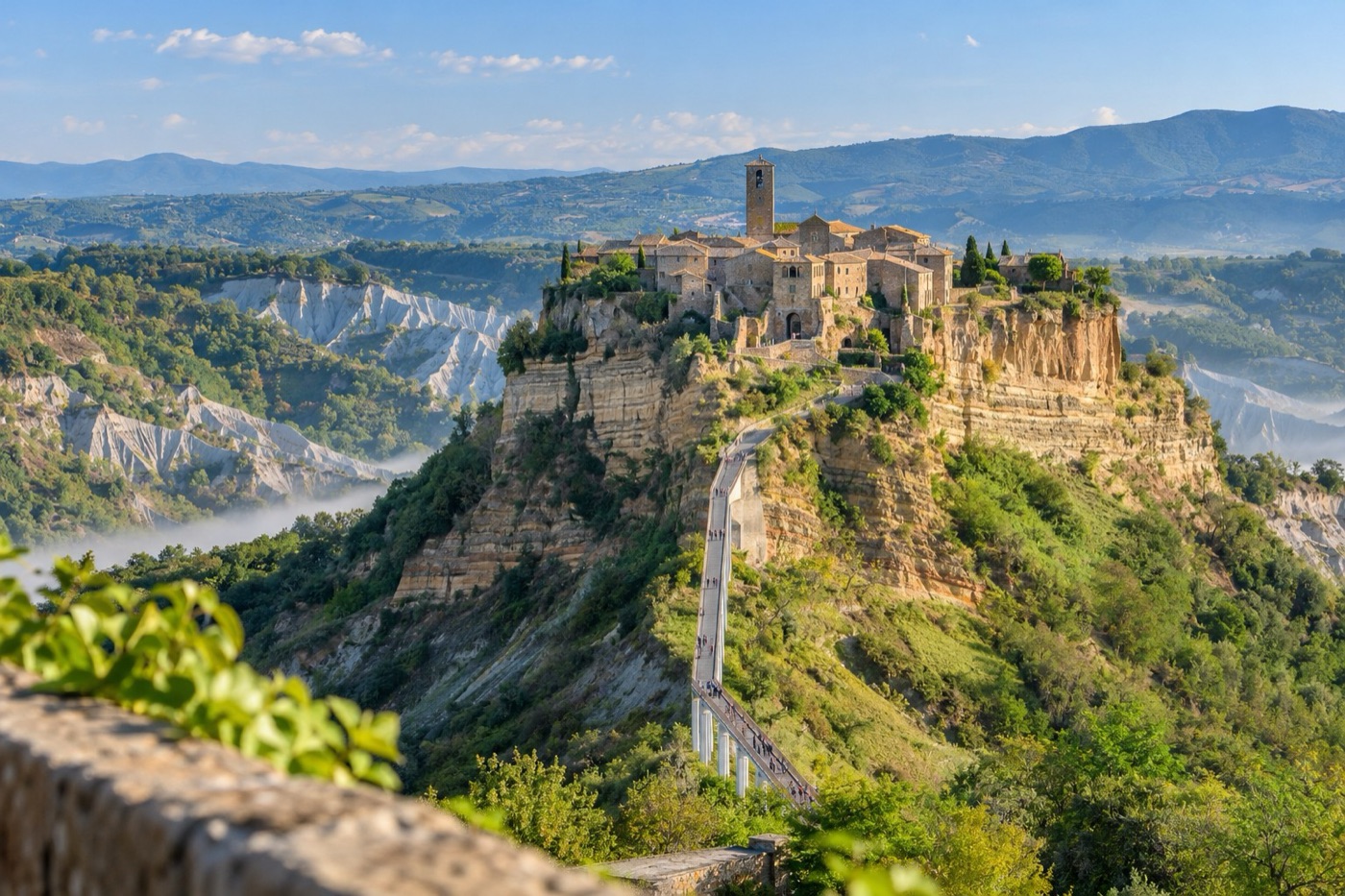
The bridge to Civita di Bagnoregio hangs high above a valley. Visitors walk across it towards stone houses, narrow streets and a view that looks almost unreal. Then they look down. Rain and wind are slowly wearing away the soft rock beneath the village. Parts of the hill have already disappeared. Civita is beautiful, famous and in physical danger, which is why local people have long called it the Dying Town.
The village was founded more than 2,500 years ago, but only a small number of people now live permanently in its old centre. Tourists turn up in large numbers at busy times, then leave again. A crowded afternoon can hide the harder question: who will live and work there all year? A real community needs safe buildings, services and jobs, not only visitors taking photographs.
In October 2026, Italy's culture minister announced that Civita and the nearby town of Bolsena had won the title of Italian Capital of Contemporary Art for 2028. Their joint project will receive one million euros for cultural activities. The plan includes art projects, events and spaces where creative people can work. Organisers also hope to involve young people and schools. These are plans for the years ahead, not results yet.
The announcement is good news for the area. Exhibitions and cultural events could bring visitors at different times of the year and encourage people to stay longer. Local cafés, guesthouses and small businesses may benefit. Art could also give young people more reasons to study and work nearby instead of moving to a bigger city. But attracting tourists is not the same as building a community where people want to live all year.
There is also a problem that art cannot solve on its own. Civita's hill is still slowly changing, and protecting its buildings needs engineering work and money. The new cultural title offers a chance to look beyond the village's famous views and think about its future. Whether it succeeds will depend on what happens after the visitors have gone home. A village needs more than attention to stay alive.
Intermediate version
Halfway across the footbridge to Civita di Bagnoregio, the village seems to float above the valley. Its medieval buildings attract cameras from every direction, but the dramatic view is also a warning. Erosion has been eating into the soft rock for centuries. The hilltop is not merely picturesque; it is unstable. Civita's nickname, the Dying Town, describes both the land falling away and the tiny community trying to remain on it.
The settlement dates back more than 2,500 years, yet only a handful of people now live permanently in its old centre. Tourism keeps businesses going, but it does not automatically restore the services, employment and ordinary routines that make year-round life possible. In summer, the bridge can be full. In winter, the difference between a successful attraction and a living village becomes much harder to ignore.
In October 2026, Civita and the nearby lakeside town of Bolsena received an unexpected opportunity. The two places were chosen together as Italy's Capital of Contemporary Art for 2028, beating other finalists including Capri, Padua and Pozzuoli. The winning project, called "Arte che viene, arte che va", will receive one million euros in public funding. Its organisers hope to develop exhibitions, creative spaces and programmes involving schools and young artists.
The decision is more ambitious than simply organising a festival for visitors. Supporters want contemporary art to become part of local life, connecting old buildings and landscapes with new ideas. If the programme attracts artists, students and cultural organisations, it could generate work and help businesses outside the main tourist season. Small communities can sometimes benefit more from steady activity than from occasional crowds.
There are reasons to be cautious, however. Tourism does not automatically reverse population decline. A village can become a popular place to visit while becoming too expensive or inconvenient for local people to live in. Civita also faces an unusually serious physical threat. The erosion of its hilltop requires engineering expertise, careful planning and long-term investment. Art cannot hold the ground together.
Still, the award changes the conversation. Instead of being known only as a beautiful place that may eventually disappear, Civita has a chance to become a centre for new cultural activity. The true test will come after 2028, when the exhibitions have ended and the publicity has died down. If the project helps people work, create and remain in the area, it may offer the village something more valuable than another successful tourist season.
Advanced version
The long footbridge to Civita di Bagnoregio creates the perfect approach to a beautiful place, and exposes the reason for its fragility. Medieval houses cling to a shrinking fragment of hilltop above the eroded valleys of northern Lazio. Visitors pause to photograph the spectacle; beneath them, rain and wind continue working on the soft volcanic material. "La Città che Muore", the Dying Town, is not simply an evocative nickname. The ground beneath the village is slowly wearing away.
Civita has survived since Etruscan times, but permanent settlement has dwindled to a tiny community. Tourism sustains cafés and guesthouses without solving the familiar problems of rural depopulation: limited employment, fragile services and the departure of younger residents. The contrast between a crowded visitor route and a nearly empty village raises an awkward question. Can a place remain culturally alive if it functions mainly as scenery? The question is hardly unique to Civita, but few places in Italy pose it quite so starkly.
An answer, or at least a new experiment, came along in October 2026 when Civita and nearby Bolsena were jointly designated Italy's Capital of Contemporary Art for 2028. Their proposal, "Arte che viene, arte che va", won against entries from Capri, Padua and Pozzuoli, securing a million euros of public funding. The scheme envisages more than temporary exhibitions. Its ambitions include creative infrastructure, collaboration with educational institutions and opportunities for younger artists to engage with the region.
The choice reflects an increasingly influential view of culture as a tool for regional development. A well-designed programme can bring in investment, new partnerships and year-round activity to places otherwise known largely for their heritage. Contemporary art may also challenge the tendency to treat historic villages as finished objects, picturesque surroundings to be consumed rather than communities capable of change.
Yet cultural projects often struggle to convert short-term attention into durable economic opportunities. Funding cycles come to an end, visiting artists move on, and the institutions left behind are frequently too thinly staffed to shore up what the programme began. Whether Civita and Bolsena can avoid that familiar pattern is, for the moment, an open question.
Civita's particular vulnerability makes this tension sharper. Art can stimulate discussion and attract resources, but it cannot remedy the erosion of the volcanic material supporting the settlement. Conservation and engineering remain indispensable, as does investment in the practical conditions that enable permanent residents to stay. There is a risk, too, that an increasingly celebrated village becomes more attractive to visitors and property investors than to people seeking an ordinary home.
The significance of the 2028 programme will therefore depend on what survives it. Temporary installations and a crowded calendar may bring welcome publicity, but they will not in themselves secure a future for Civita or Bolsena. More meaningful success would involve permanent spaces for creative work, stronger local institutions and reasons for younger generations to remain connected to the area. The Dying Town does not need art to disguise its fragility. It needs a cultural project capable of working alongside the less glamorous business of keeping a community alive.
After you read
4True, false or not given5 statements
Choose T (true), F (false) or NG (the article does not say).
- The village has fewer than twenty permanent residents.
Not stated. The text only says a small number of people live there permanently, not how many.
- Civita won the title on its own, without any other town.
The text says the opposite: "In October 2026, Italy's culture minister announced that Civita and the nearby town of Bolsena had won the title of Italian Capital of Contemporary Art for 2028."
- People first built Civita over 2,500 years ago.
The text says: "The village was founded more than 2,500 years ago, but only a small number of people now live permanently in its old centre."
- Civita and Bolsena will be given a million euros for cultural work.
The text says: "Their joint project will receive one million euros for cultural activities."
- The plans for the arts programme have already produced results.
The text says: "These are plans for the years ahead, not results yet."
5Vocabulary5 gaps
Complete the sentences with words from the box. Two words are not needed.
attentioncrowdedencourageengineeringexpensiveimproveservices
- Cheap train tickets could more people to visit in winter.
- Shops, buses and doctors are all that a village needs.
- The streets are so at lunchtime that it is hard to walk.
- Repairing an old bridge is difficult and needs a lot of work.
- The news gave the little town a lot of from newspapers and television.
6Verb forms5 gaps
Write the correct form of the verb in brackets.
- The village more than 2,500 years ago. (FOUND)
- Only a small number of people now permanently in the old centre. (LIVE)
- Parts of the hill have already . (DISAPPEAR)
- Italy's culture minister the award in October 2026. (ANNOUNCE)
- Organisers also hope young people and schools. (INVOLVE)
7Language focusphrasal verbs
Complete the sentences with words from the box. Two words are not needed. Many phrasal verbs are a verb plus a small word. The small word, such as down or away, changes the meaning, so choose the one that fits the whole idea.
alongawaybeyonddownonthroughup
- The bridge is very high, so some visitors are afraid to look into the valley.
- Young people may drift if the village has no jobs for them.
- Whether the plan succeeds will depend what happens after the festival.
- A good plan must look the festival and think about the next ten years.
- In summer the village fills with visitors.
4True, false or not given5 statements
Choose T (true), F (false) or NG (the article does not say).
- The writer suggests that a busy summer does not prove Civita is a healthy community.
The text contrasts a full bridge in summer with the winter difference between "a successful attraction and a living village".
- The text suggests that art can protect the hilltop from further erosion.
The text says: "Art cannot hold the ground together."
- Organisers have already chosen the first artists to take part.
The text only says what the organisers hope to develop, not who has been chosen.
- Capri, Padua and Pozzuoli all failed to win the 2028 title.
The winning pair is described as "beating other finalists including Capri, Padua and Pozzuoli".
- The writer expects the project's real success to be judged before 2028.
The text says: "The true test will come after 2028."
5Vocabulary6 gaps
Complete the sentences with words from the box. Two words are not needed.
convertdeclineexcessiveexpertisefundinggenerateoccasionalunstable
- Engineers closed the path because the slope above it had become .
- Repairing an old stone wall takes specialist that few builders have.
- Festivals can income for local shops, restaurants and hotels.
- Many rural areas face a steady in population as young people move to cities.
- Without public , the small theatre would have to close.
- Visitors in winter are rare, and the tourist usually leaves by lunchtime.
6Verb forms5 gaps
Write the correct form of the verb in brackets.
- By the time the engineers arrived, the rain part of the path away. (WASH)
- The summer festival in the main square every year. (HOLD)
- If the village had more jobs, fewer young people . (LEAVE)
- Since the festival was announced, local hotels many more bookings. (RECEIVE)
- The two towns together in October 2026. (CHOOSE)
7Language focusphrasal verbs
Complete the sentences with words from the box. Two words are not needed. Check the form after the gap (-ing, -s or the base form). The small word that follows, such as into, away, back or down, tells you which verb to choose.
datesdieeatingfallingholdspreadstand
- Rising repair costs are slowly into the village's budget.
- The ground at the edge of the village is away.
- The oldest church in the town back to the twelfth century.
- When the summer crowds down, most cafés close for the winter.
- Engineers will need to the hillside together.
4True, false or not given5 statements
Choose T (true), F (false) or NG (the article does not say).
- The writer implies that Civita looks far busier in summer than it is lived in.
The text contrasts "a crowded visitor route" with "a nearly empty village".
- The writer believes cultural projects reliably turn publicity into lasting jobs.
The text says such projects "often struggle to convert short-term attention into durable economic opportunities".
- Bolsena will host more of the 2028 events than Civita.
The text does not say how the events will be shared between the two places.
- The writer suggests that Civita's problem is shared by other places, though few face it so sharply.
The text says the question "is hardly unique to Civita, but few places in Italy pose it quite so starkly".
- The writer says the programme will be judged mainly by the size of the 2028 crowds.
The text says its significance "will depend on what survives it", and that a crowded calendar will not secure a future.
5Vocabulary6 gaps
Complete the sentences with words from the box. Two words are not needed.
designateddurableephemeralforestallremedystarklystimulatesustains
- Short-term publicity is rarely enough; towns need income that lasts beyond a single festival.
- No amount of public art can the damage once a cliff has begun to collapse.
- The mayor hopes a summer of installations will interest among younger residents who have drifted away.
- Only a handful of buildings in the old centre have been as protected monuments.
- The empty winter lanes contrast with the crowded bridge in August.
- Seasonal tourism a few cafés but creates little year-round employment.
6Word forms5 gaps
Use the word in brackets to make a word that fits the gap.
- The long-term of the scheme will depend on whether local residents become involved. (SUSTAIN)
- A full of an old stone bridge would cost far more than a festival. (RESTORE)
- Residents were by the sudden rise in rents. (SETTLE)
- Some locals remain about whether art can solve practical problems. (SCEPTIC)
- The of soft volcanic rock makes any repair work a delicate task. (FRAGILE)
7Language focusphrasal verbs
Complete the sentences with words from the box. Two words are not needed. Particles change the meaning completely. Read the small word after the gap, then pick the verb that forms a phrasal verb with it. Some verbs split around an object.
fallironpeterscalestavetidewear
- The grant will help the museum off closure for another year.
- Attendance tends to out once the novelty of a festival fades.
- Without further funds, the council may have to back the programme.
- Residents hope the new income will the village over until spring.
- Organisers must out the disagreements over who owns the new studios.
Speak
8Talk about it3 questions
Discuss in pairs or small groups. Give reasons for your answers.
- What would persuade younger people to stay in a small town?
- Would you rather protect a place exactly as it is or let it change?
- What should still be there after a big cultural festival ends?
8Talk about it3 questions
Discuss in pairs or small groups. Give reasons for your answers.
- What would persuade younger people to stay in a small town?
- Would you rather protect a place exactly as it is or let it change?
- What should still be there after a big cultural festival ends?
8Talk about it3 questions
Discuss in pairs or small groups. Give reasons for your answers.
- What would persuade younger people to stay in a small town?
- Would you rather protect a place exactly as it is or let it change?
- What should still be there after a big cultural festival ends?
9Role-play: how to spend the money
Work in pairs. Read your card, then have the conversation. Swap roles and do it again.
Student A · a neighbour who wants practical repairs
Your small town has won 100,000 euros. You think the money should pay for a safer bridge and a better bus service. Explain why, and ask your neighbour two questions about their idea.
Student B · a neighbour who wants an art festival
Your small town has won 100,000 euros. You think the money should pay for an art festival that brings visitors and young people. Explain why, and ask your neighbour two questions about their idea.
Useful phrases
- I'd rather spend the money on something people can use.
- That's a fair point, but it won't last.
- What would happen if nobody came?
- I'm not sure that's the best idea.
- We're not going to agree on everything.
- Could we split the money between both plans?
Afterwards, tell the class: how did you decide to spend the money, and was it a fair deal?
Your words
Highlights0 saved
Highlights0 saved
Highlights0 saved
Was this lesson useful? Support johnplusnews on Ko-fi
Continue reading
Food
The Chef Who Lost His Job Over Pineapple
An Italian chef in Australia was sacked for refusing to add pineapple. A food historian says the rule he was defending is younger than he thinks.
History
Were People Getting High 2,800 Years Ago?
Cannabis seeds and chemical traces in preserved hair from a Siberian tomb suggest that some Scythians were exposed to its intoxicating compounds about 2,800 years ago. The evidence is strong, but it leaves many questions open.
Travel
What Happens When One of the World's Quietest Places Gets Easier to Visit?
Greenland now has three new airports and more visitors than ever, but tourism is still a small part of its economy. Some residents worry about what a rush of visitors could do to a quiet place with a fragile environment.