The School Sketch That Led to a Book
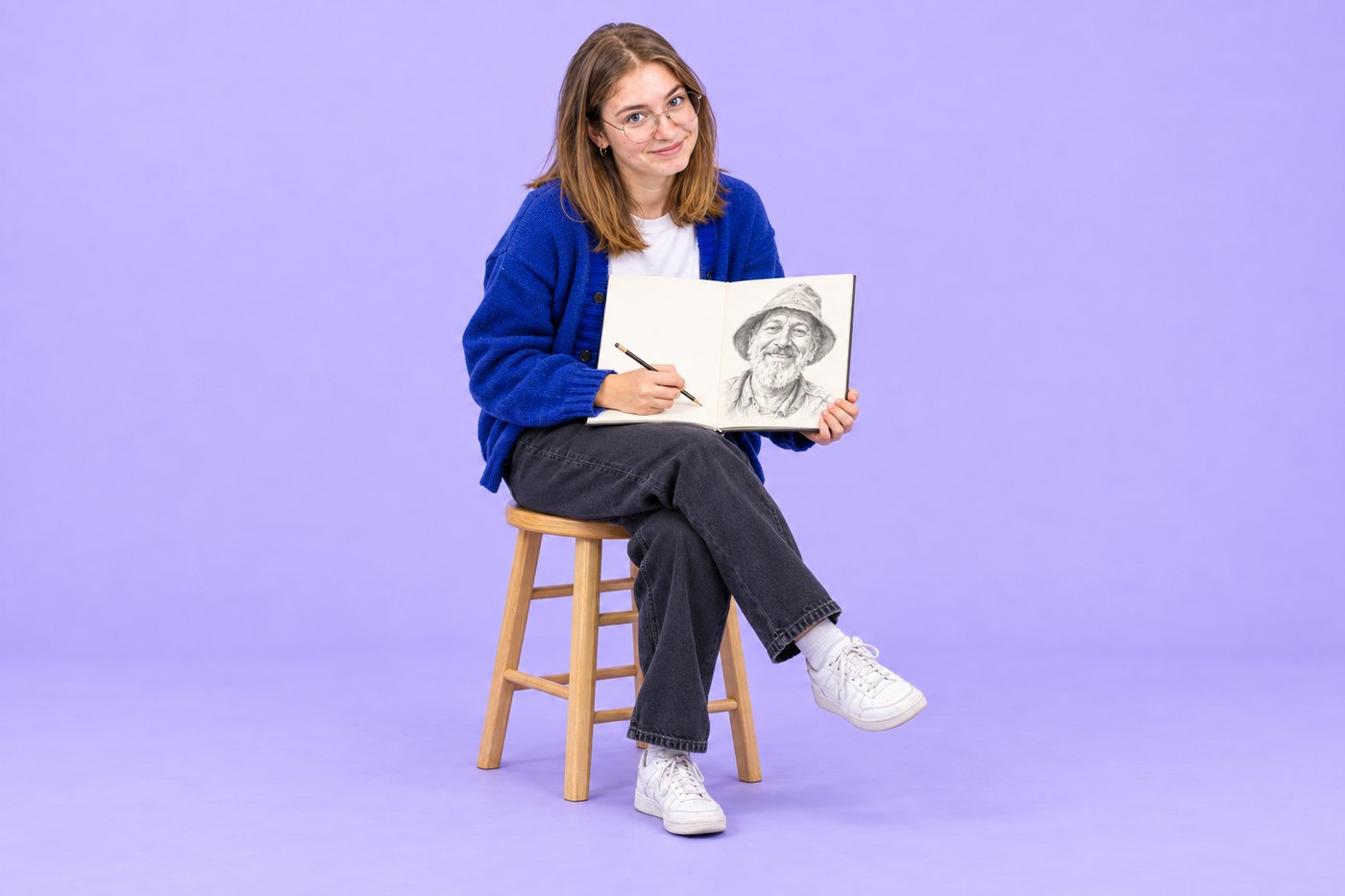
A 15-year-old drew the author who was visiting her school. The portrait led to a published book.
Warm up3 questions
- What would you draw if a publisher asked for one page?
- Would you show unfinished work to someone you admired?
- Which school project would you enjoy turning into something bigger?
Sentence help (optional): I'd choose ... because ... · For me, ... · I think ... because ...
Warm up3 questions
- What would you draw if a publisher asked for one page?
- Would you show unfinished work to someone you admired?
- Which school project would you enjoy turning into something bigger?
Warm up3 questions
- What would you draw if a publisher asked for one page?
- Would you show unfinished work to someone you admired?
- Which school project would you enjoy turning into something bigger?
Core version
Imagine you are in the audience at a school event. A storyteller is on the stage. You do not want to speak in front of everyone, but you do want to do something. So you take out a pencil and start to draw.
That is what Bethany did. She is 15 and lives in Cambridgeshire, in England. An author called Chip Colquhoun visited her school to tell stories. Bethany drew a portrait of him while she listened. She says that drawing helped her to focus.
Colquhoun loved the drawing. He said that it wowed him. He used her portrait in one of his books for teachers. Later, he asked her to draw the pictures for a new children's book, The Bestest Story in the World Ever! The book came out in September 2026. Bethany says it felt strange and unreal to see her pictures in print.
Bethany finds it very hard to talk to some people, especially people she does not know well. This is called situational mutism. She says that illustrating has given her a lot more confidence. She can now do things that she could not do a few years ago. Her mother says that Bethany still needs support, but that she now has the chance to feel proud.
Bethany is now working on a third book. She often draws in the evening and does her schoolwork earlier in the day.
What can we learn? A person who is quiet may have a lot to say in another way. Think about how you could encourage a friend who makes something. A kind and specific comment, like "I love the colours here", is better than a vague "good job". What would you say?
Intermediate version
Imagine you are sitting in the audience at a school storytelling session. You would rather not speak in front of everyone, but you do not want to sit with nothing to do either. So you take out a pencil and start to draw.
That is how Bethany, a 15-year-old from Cambridgeshire, began a project that became a real book. When the author Chip Colquhoun visited her school to give a storytelling session, she drew a portrait of him. She told BBC Radio Cambridgeshire that she drew it to concentrate. She needed something to draw, and he was right there.
Colquhoun was impressed. He said that her portrait wowed him, and that he was excited by the idea that she had used drawing to help her focus. He later used the portrait in one of his books, a guide for teachers on using storytelling. Then he asked her to illustrate his children's book The Bestest Story in the World Ever!, which was published in September 2026.
Bethany says that seeing her illustrations in print felt weird and unreal. She describes her first portrait as very stylised and says it is not the style she draws in now, although she thinks it was good for her skill level at the time.
The BBC report also explains that Bethany has situational mutism. In her words, she speaks to some people and not to others, mainly people she does not know or does not feel comfortable with. Her mother, Fiona, says that Bethany has full language skills but that in certain situations she cannot use them, and that it comes from anxiety. Bethany still cannot go anywhere outside the house or school on her own.
Bethany says that illustrating has improved her confidence a lot. According to her mother, she has been to two book launches and has been interviewed by two radio stations, with support. She is now working on a third book and on three drawings for another project. She usually draws in the evening and does her schoolwork earlier in the day.
It would be wrong to read this as a story in which art cured a problem. The report does not say that, and Bethany's mother is clear that support is still needed. What it does show is that a person who finds speaking hard may have another way to take part, and that being noticed in a way that suits her helped.
Think about a friend who makes something creative. How could you encourage them without putting them under pressure? A specific comment, a curious question and an optional suggestion can all help more than a vague "good job".
Advanced version
During a school storytelling visit, Bethany drew the author in front of her. She later told the BBC that drawing helped her concentrate. The author, Chip Colquhoun, noticed the portrait. That small exchange led to something she had not expected: an invitation to illustrate a book.
The girl, Bethany, was in the audience at a school storytelling session given by the author Chip Colquhoun. She drew a portrait of him. She told BBC Radio Cambridgeshire that she did it as a way to concentrate, because she needed something to draw and he was right there. Colquhoun said that the portrait wowed him, and that he was excited by the idea that she had used drawing to help her focus.
What followed was practical. He used the portrait in one of his books, a guide for teachers on using storytelling, and later asked her to illustrate his children's book The Bestest Story in the World Ever!, published in September 2026. Bethany says that seeing her work in print felt weird and unreal. She now describes that first portrait as very stylised, and says it is not the style she draws in today.
The report also gives context that is important for reading the story fairly. Bethany has situational mutism. She says that she speaks to some people and not to others, mainly people she does not know or does not feel comfortable with. Her mother, Fiona, says that Bethany has full language skills but that in some circumstances she cannot use them, and that it comes from anxiety. This is not rudeness, and it is not a choice.
Bethany says that illustrating has improved her confidence a great deal and made her able to do things that she would have been too nervous to do a few years ago. According to her mother, she has been to two book launches and has been interviewed by two radio stations, and she is now working on a third book and on three drawings for another project. Her mother is also clear about the limits: Bethany still cannot do these things alone, and she still cannot go anywhere outside the house or school without support.
This is not a story in which a talent solves a problem, and the report does not say it is. Creative success is not what makes a person deserve support. What the story does show is that when someone finds one way of taking part difficult, another may be available, and being noticed in a way that suits them can make a real difference.
It also shows something about the person who noticed. Colquhoun did not ask Bethany to speak. He looked at what she had made and answered it with a real job. Encouragement that responds to a person's actual work, in the form that suits them, is often more useful than general praise.
If you noticed a friend's creative talent, how could you encourage them without putting them under pressure?
Study this story
Save the words you want to keep, talk about the story, then practise the language.
Highlights0 saved
Highlights0 saved
Highlights0 saved
Talk about it3 questions
- What could make it easier for a young person to share their work?
- Would an important opportunity make a hobby more fun or more stressful?
- What should adults do when they spot a young person's talent?
Sentence help (optional): I think ... because ... · One reason is ... · For me, ...
You can talk about people in general instead of yourself, and you can pass on any question.
Talk about it3 questions
- What could make it easier for a young person to share their work?
- Would an important opportunity make a hobby more fun or more stressful?
- What should adults do when they spot a young person's talent?
You can talk about people in general instead of yourself, and you can pass on any question.
Try it
Imagine a classmate has drawn a picture. In pairs, write three pieces of feedback for the picture: one specific observation (for example, "I like how the colours change at the top"), one curious question and one optional suggestion. Then write a vague "good job" and compare. Which kind of note would help you most if it were your picture, and why? Use an invented drawing. Sharing personal artwork is always optional, and nobody has to talk about private matters.
Exercises4 exercises
1. Complete the sentences
Drag a word into each gap, or tap a word and then tap a gap. Tap a filled gap to put the word back. Two words are not needed.
- Bethany drew a of the author while she listened.
- She says that drawing helped her to .
- Chip Colquhoun asked her to draw the for a new children's book.
- Illustrating has given her a lot more .
- A kind and specific is better than a vague "good job".
2. Match the meaning
Choose the meaning of each word or phrase as it is used in the article.
- illustrating
- author
- vague
- encourage
Write the letter of the meaning next to each word.
- A a person who writes books
- B to give someone support and hope so they keep trying
- C making drawings for a book
- D not clear or exact
3. Put the verb in the right form
Write the correct form of the verb in brackets.
- Colquhoun loved the drawing. He it in one of his books for teachers. (use)
- Later, the book out in September 2026. (come)
- She often in the evening. (draw)
- A person who is quiet may a lot to say in another way. (have)
- Bethany is now on a third book. (work)
4. True, false or not given
Choose Not given if the article does not say, even when you think the statement is probably true.
- Bethany drew the visiting author during his event.
The text says: "Bethany drew a portrait of him while she listened."
- Colquhoun did not like the drawing.
The text says the opposite: "Colquhoun loved the drawing."
- The book has been translated into other languages.
Not stated. The text does not say whether the book has been translated.
- Colquhoun put the picture in a book for teachers.
The text says: "He used her portrait in one of his books for teachers."
- Bethany does her schoolwork in the evening.
The text says the opposite: "does her schoolwork earlier in the day"
Your score
Do all four, then add them up.
Answer key
- Complete the sentences1 portrait · 2 focus · 3 pictures · 4 confidence · 5 comment
- Match the meaning1 illustrating = C · 2 author = A · 3 vague = D · 4 encourage = B
- Put the verb in the right form1 used · 2 came · 3 draws · 4 have · 5 working
- True, false or not given1 True · 2 False · 3 Not given · 4 True · 5 False
1. Complete the sentences
Drag a word into each gap, or tap a word and then tap a gap. Tap a filled gap to put the word back. Two words are not needed.
- She did it to during the session.
- Bethany says seeing her illustrations in print felt weird and .
- Colquhoun asked her to his children's book.
- She describes her first portrait as very , which means not completely realistic.
- A comment helps more than a vague "good job".
2. Match the meaning
Choose the meaning of each word or phrase as it is used in the article.
- portrait
- impressed
- pressure
- optional
Write the letter of the meaning next to each word.
- A something you can choose to do or not do
- B a feeling of being pushed to do something or do it well
- C a drawing or photograph of a person
- D feeling admiration for something good
3. Put the verb in the right form
Write the correct form of the verb in brackets.
- When the author visited her school, Bethany a portrait of him. (draw)
- He later the portrait in one of his books. (use)
- The book published in September 2026. (be)
- According to her mother, she has to two book launches. (be)
- She usually in the evening and does her schoolwork earlier in the day. (draw)
4. True, false or not given
Choose Not given if the article does not say, even when you think the statement is probably true.
- Colquhoun included Bethany's portrait in one of his books.
The text says: "He later used the portrait in one of his books"
- Bethany says she still uses the same style as in her first portrait.
The text says the opposite: "it is not the style she draws in now"
- The author's book has been translated into other languages.
Not stated. The text does not say whether the book has been translated.
- Bethany has attended two book launches.
The text says: "she has been to two book launches"
- The text says that art cured Bethany's difficulties.
The text says the opposite: "It would be wrong to read this as a story in which art cured a problem"
Your score
Do all four, then add them up.
Answer key
- Complete the sentences1 concentrate · 2 unreal · 3 illustrate · 4 stylised · 5 specific
- Match the meaning1 portrait = C · 2 impressed = D · 3 pressure = B · 4 optional = A
- Put the verb in the right form1 drew · 2 used · 3 was · 4 been · 5 draws
- True, false or not given1 True · 2 False · 3 Not given · 4 True · 5 False
1. Complete the sentences
Drag a word into each gap, or tap a word and then tap a gap. Tap a filled gap to put the word back. Two words are not needed.
- She drew the portrait as a way to , because she needed something to draw.
- Colquhoun later asked her to his children's book.
- She now describes that first portrait as very .
- That small exchange led to something she had not .
- He looked at what she had made and answered it with a real .
2. Match the meaning
Choose the meaning of each word or phrase as it is used in the article.
- deserve
- circumstances
- exchange
- limits
Write the letter of the meaning next to each word.
- A the conditions and facts around a situation
- B the points beyond which something cannot go
- C to have earned something, or to be worthy of it
- D a short conversation or contact between people
3. Make the right word
Use the word in brackets to make a word that fits the gap.
- Illustrating has improved her a great deal. (CONFIDENT)
- that responds to a person's actual work is often more useful than general praise. (ENCOURAGE)
- Creative is not what makes a person deserve support. (SUCCEED)
- What followed was . (PRACTICE)
- She would have been too to do these things a few years ago. (NERVE)
4. True, false or not given
Choose Not given if the article does not say, even when you think the statement is probably true.
- Colquhoun included Bethany's portrait in one of his books.
The text says: "He used the portrait in one of his books"
- The text says the report presents Bethany's difficulties as rudeness.
The text says the opposite: "This is not rudeness, and it is not a choice."
- The book has been translated into other languages.
Not stated. The text does not say whether the book has been translated.
- Bethany has been to two book launches, according to her mother.
The text says: "she has been to two book launches"
- The text says Bethany can now do these things without support.
The text says the opposite: "Bethany still cannot do these things alone"
Your score
Do all four, then add them up.
Answer key
- Complete the sentences1 concentrate · 2 illustrate · 3 stylised · 4 expected · 5 job
- Match the meaning1 deserve = C · 2 circumstances = A · 3 exchange = D · 4 limits = B
- Make the right word1 confidence · 2 Encouragement · 3 success · 4 practical · 5 nervous
- True, false or not given1 True · 2 False · 3 Not given · 4 True · 5 False
Continue reading
Sport
Gilberto Mora: A World Cup Debut at 17
A 17-year-old midfielder played for Mexico at the World Cup. His coach and a teammate explain what makes him stand out, and what it takes to be the youngest in the team.
Science & making
The Teen Who Turned Paper Folding into Research
A 17-year-old from Japan won a top science prize for studying how folded shapes move, starting from a ladybird's wing.
Hobbies
The Teen Who Found His People Through a Puzzle
A 15-year-old from the north of England got a Rubik's Cube as a present, then found a community of people who love the same puzzle.


Read this article online: johnplusnews.com/articles/the-school-sketch-that-led-to-a-book/