The Teen Who Turned Paper Folding into Research
A 17-year-old from Japan won a top science prize for studying how folded shapes move, starting from a ladybird's wing.
Warm up3 questions
- What could you make from one sheet of paper?
- Would you rather follow instructions or invent a design?
- Can an ordinary hobby turn into a serious question?
Sentence help (optional): I'd choose ... because ... · For me, ... · I think ... because ...
Warm up3 questions
- What could you make from one sheet of paper?
- Would you rather follow instructions or invent a design?
- Can an ordinary hobby turn into a serious question?
Warm up3 questions
- What could you make from one sheet of paper?
- Would you rather follow instructions or invent a design?
- Can an ordinary hobby turn into a serious question?
Core version
Have you ever folded paper into a bird or a boat? You fold it, and then you open it again. It seems like a simple game. But for one student, it became a science question.
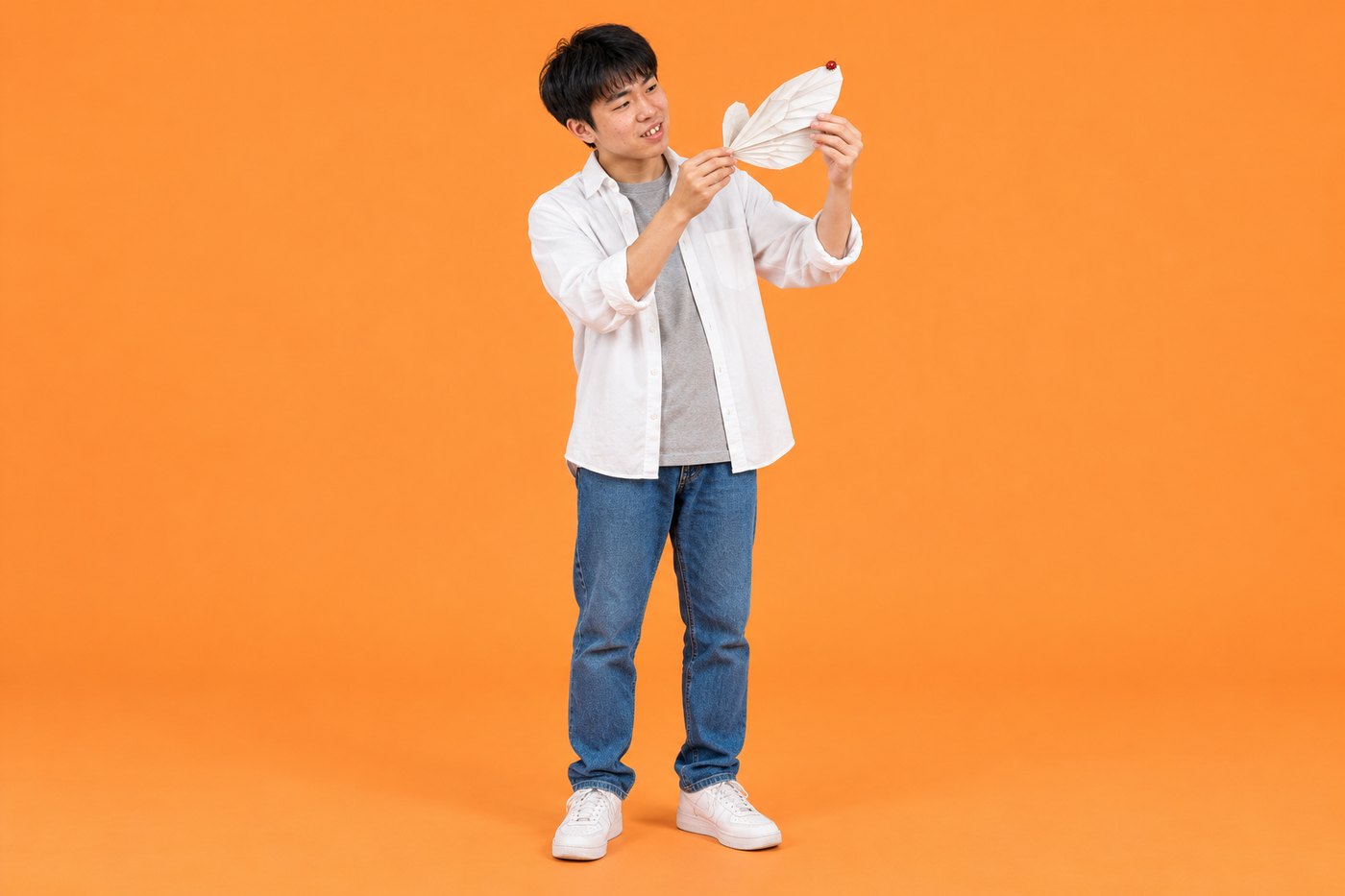
Hikaru Kuribayashi is 17 and lives in Japan. He asked: how do folded things move? Many things in nature are folded, like the wing of a ladybird. The wing opens and closes, and it is full of creases. Hikaru says that this is a kind of origami made by nature.
He did not win for making paper animals. Folding paper alone is not science. He turned his question into research and computer work. In May 2026, he took part in a big science fair in Phoenix, in the United States, called Regeneron ISEF, and won a prize of $100,000. He goes to Sapporo Kaisei Secondary School.
Hikaru built a computer model of a ladybird wing. In his model, the wing opens and closes like a real wing. He used only the folds and small dents to work out how a shape can move. He also made a physical model to show the movement.
Hikaru says that many engineers study one movement at a time. His method looks at many possible movements. He thinks this could help scientists design new technology that copies nature. This is only an idea for now.
The story shows something simple. A hobby can hide a question. Which of your hobbies could lead to a question? And could a hobby be worth your time even if it never wins a prize?
Intermediate version
Think of something you do for fun, like folding paper or building with blocks. Could it hide a serious question? For one student in Japan, it did.
Hikaru Kuribayashi, aged 17, from Sapporo Kaisei Secondary School, won the $100,000 George D. Yancopoulos Innovator Award at the 2026 Regeneron International Science and Engineering Fair in Phoenix, Arizona. He also won first place in the physics category, worth $6,000. The report was published on 18 May 2026 by Science News Explores. It comes from the organisation that runs the fair, so it is not an independent check.
His project was about folding, but not about making paper animals. Its title was "MCMC Sampling of Origami and Linkages", and it was research and computer work. His starting point was nature. Hikaru calls folded structures in nature a form of origami, and he used a ladybird's wing as an example, because it opens and closes and is full of creases.
Folding is useful whenever something must be small when it is stored and larger when it is used. A wing is one example. That is why designers are interested in how folded structures open and close, and why Hikaru's question is not as strange as it first sounds.
Hikaru's software helps work out how a folded shape can move. Engineers who study folding structures often map every shape a structure could take and then calculate the paths between them, which Hikaru says follows one motion at a time. His method uses probability, and it uses only the creases and the dotted indentations on a folded shape to model possible motions, including the temporary bending of flexible materials. He built a computer model of the ladybird wing and showed its movement with a physical model.
The article suggests some possible uses: designing technology inspired by nature, analysing the way birds move, and modelling any mechanism that can be reduced to dots and lines. It is important to read these as possibilities. The article does not describe a finished product, and it does not independently check Hikaru's claims that his method can model every motion or that older methods cannot.
The story is not really about winning money. It is about a question hidden inside a hobby. Which hobby would you enjoy explaining to someone who knew nothing about it? And could a project be worthwhile even if it never wins a prize or becomes a product?
Advanced version
A folded sheet of paper can become a shape far larger than it looks when packed away. A ladybird's wing does something more useful: it folds up, then opens for flight. For Hikaru Kuribayashi, that movement offered a question to investigate. How could a computer work out the ways a folded structure might move?
In May 2026, the 17-year-old student from Sapporo Kaisei Secondary School in Japan won a major award for his research. He received the $100,000 George D. Yancopoulos Innovator Award at Regeneron ISEF, an international science and engineering fair in Phoenix, Arizona. He also won first place in the physics category. The work behind the prizes involved software as well as folds.
The difficulty is that a flexible structure can change in several ways at once. A crease influences where it bends, but the material can also warp as it moves. According to Hikaru, that makes some existing ways of calculating motion too limited. His approach uses probability to explore movement from information about the structure's creases and other key points.
To show the idea, he built a computer model of a ladybird's wing opening and closing. He also demonstrated it with a physical model. That made an unfamiliar piece of research easier to picture: the question was not just what shape something could become, but how it could get from one shape to another.
The account comes from Science News Explores, which is published by the organisation behind the fair. Its explanation draws on Hikaru's description of his work. Broad claims about everything the method can do should therefore stay attributed to him. The report describes research, not a finished product that has been tested and put on sale.
Possible uses include helping designers understand mechanisms inspired by nature. Those possibilities still need investigating. The immediate achievement is more specific: Hikaru took a movement he could observe and developed a way to study it. Paper folding and a beetle's wing were starting points for the same problem. Looking closely turned a familiar action into something worth working out.
Study this story
Save the words you want to keep, talk about the story, then practise the language.
Highlights0 saved
Highlights0 saved
Highlights0 saved
Talk about it3 questions
- What makes this paper-folding story interesting beyond winning a prize?
- Would you keep working on an idea if most attempts failed?
- Which everyday object would you like to understand more deeply?
Sentence help (optional): I think ... because ... · One reason is ... · For me, ...
You can talk about people in general instead of yourself, and you can pass on any question.
Talk about it3 questions
- What makes this paper-folding story interesting beyond winning a prize?
- Would you keep working on an idea if most attempts failed?
- Which everyday object would you like to understand more deeply?
You can talk about people in general instead of yourself, and you can pass on any question.
Try it
Take a scrap sheet of paper and fold it into a simple shape, or describe a fold on paper without cutting anything. Then write one useful question about strength, size or movement, such as "which fold lets the paper hold more weight?" and say how you could compare two versions fairly. This is a classroom analogy only, not a recreation of anyone's research. Nobody needs special equipment, a computer or any money.
Exercises4 exercises
1. Complete the sentences
Drag a word into each gap, or tap a word and then tap a gap. Tap a filled gap to put the word back. Two words are not needed.
- Folding paper alone is not .
- In May 2026, he took part in a big in Phoenix, in the United States.
- The wing of a ladybird opens and .
- He used only the folds and small dents to work out how a shape can .
- Using the model for new technology is only an for now.
2. Match the meaning
Choose the meaning of each word or phrase as it is used in the article.
- creases
- origami
- model
- research
Write the letter of the meaning next to each word.
- A the art of folding paper into shapes
- B the lines that are made in paper when it is folded
- C careful study to find out new facts
- D a smaller or simpler version of something, used to study it
3. Put the verb in the right form
Write the correct form of the verb in brackets.
- In May 2026, Hikaru a prize of $100,000. (win)
- Before the competition, Hikaru a computer model of a ladybird wing. (build)
- He did not win for making paper animals. He his question into research. (turn)
- The wing of a ladybird many creases. (have)
- He thinks this could scientists design new technology. (help)
4. True, false or not given
Choose Not given if the article does not say, even when you think the statement is probably true.
- Hikaru went to a competition in the United States.
The text says: "In May 2026, he took part in a big science fair in Phoenix, in the United States"
- Hikaru won a prize for making paper animals.
The text says the opposite: "He did not win for making paper animals."
- More than 1,000 students took part in the event.
Not stated. The text does not say how many students took part.
- Hikaru made a computer model of a ladybird wing.
The text says: "Hikaru built a computer model of a ladybird wing."
- The text says the new technology already exists.
The text says the opposite: "This is only an idea for now"
Your score
Do all four, then add them up.
Answer key
- Complete the sentences1 science · 2 fair · 3 closes · 4 move · 5 idea
- Match the meaning1 creases = B · 2 origami = A · 3 model = D · 4 research = C
- Put the verb in the right form1 won · 2 built · 3 turned · 4 has · 5 help
- True, false or not given1 True · 2 False · 3 Not given · 4 True · 5 False
1. Complete the sentences
Drag a word into each gap, or tap a word and then tap a gap. Tap a filled gap to put the word back. Two words are not needed.
- Folding is useful whenever something must be small when it is stored and larger when it is .
- His project was research and computer , not a craft project.
- A ladybird's wing opens, closes and is full of .
- His method models every possible motion, including the temporary of flexible materials.
- The article does not independently Hikaru's claims.
2. Match the meaning
Choose the meaning of each word or phrase as it is used in the article.
- mechanism
- indentations
- temporary
- probability
Write the letter of the meaning next to each word.
- A small dents or marks pressed into a surface
- B a set of parts that operate together to make something move
- C how likely it is that something will happen
- D lasting for a short time only
3. Put the verb in the right form
Write the correct form of the verb in brackets.
- At the 2026 fair, Hikaru the $100,000 award. (win)
- He a computer model of the ladybird wing and showed its movement with a physical model. (build)
- Engineers often every shape a structure could take. (map)
- The article some possible uses. (suggest)
- The report was on 18 May 2026 by Science News Explores. (publish)
4. True, false or not given
Choose Not given if the article does not say, even when you think the statement is probably true.
- Hikaru won first place in the physics category.
The text says: "He also won first place in the physics category"
- Hikaru's prize was for making paper animals.
The text says the opposite: "His project was about folding, but not about making paper animals"
- The fair is held in a different country every year.
Not stated. The text does not say where the fair is held in other years.
- Birds' movement is one possible use mentioned for his method.
The text says: "analysing the way birds move"
- The text says Hikaru's claims were tested by independent experts.
The text says the opposite: "it does not independently check Hikaru's claims"
Your score
Do all four, then add them up.
Answer key
- Complete the sentences1 used · 2 work · 3 creases · 4 bending · 5 check
- Match the meaning1 mechanism = B · 2 indentations = A · 3 temporary = D · 4 probability = C
- Put the verb in the right form1 won · 2 built · 3 map · 4 suggests · 5 published
- True, false or not given1 True · 2 False · 3 Not given · 4 True · 5 False
1. Complete the sentences
Drag a word into each gap, or tap a word and then tap a gap. Tap a filled gap to put the word back. Two words are not needed.
- A influences where a folded structure bends.
- The work behind the prizes involved as well as folds.
- Hikaru took a movement he could and developed a way to study it.
- The possible uses of the research still need .
- Broad claims about the method should stay to Hikaru.
2. Match the meaning
Choose the meaning of each word or phrase as it is used in the article.
- flexible
- warp
- demonstrated
- mechanism
Write the letter of the meaning next to each word.
- A a set of parts that work together to make something move
- B able to bend without breaking
- C to bend or twist out of the normal shape
- D showed clearly how something works
3. Make the right word
Use the word in brackets to make a word that fits the gap.
- His approach uses to explore how a folded structure might move. (PROBABLE)
- The is that a flexible structure can change in several ways at once. (DIFFICULT)
- The model made an piece of research easier to picture. (FAMILIAR)
- The immediate is more specific than a new product. (ACHIEVE)
- Its draws on Hikaru's description of his work. (EXPLAIN)
4. True, false or not given
Choose Not given if the article does not say, even when you think the statement is probably true.
- The prize-winning work included computer programs as well as folding.
The text says: "The work behind the prizes involved software as well as folds."
- The text says the article comes from a source with no link to the fair.
The text says the opposite: "published by the organisation behind the fair"
- More than 1,000 students entered the fair.
Not stated. The text does not say how many students entered the fair.
- Hikaru made a computer model of a ladybird's wing opening and closing.
The text says: "he built a computer model of a ladybird's wing opening and closing"
- The report describes a product that is already on sale.
The text says the opposite: "The report describes research, not a finished product that has been tested and put on sale."
Your score
Do all four, then add them up.
Answer key
- Complete the sentences1 crease · 2 software · 3 observe · 4 investigating · 5 attributed
- Match the meaning1 flexible = B · 2 warp = C · 3 demonstrated = D · 4 mechanism = A
- Make the right word1 probability · 2 difficulty · 3 unfamiliar · 4 achievement · 5 explanation
- True, false or not given1 True · 2 False · 3 Not given · 4 True · 5 False
Continue reading
Science & making
Can Dogs Smell When People Are Stressed?
Researchers tested whether the smell of a stressed person changes how dogs behave. The result is interesting, but it is smaller than the headlines might suggest.
Science & making
Could You Build a Satellite That Fits in a Can?
Teams of students aged 14 to 19 build a model satellite the size of a drinks can. It never reaches space, but it still has to do real science.
Sport
Gilberto Mora: A World Cup Debut at 17
A 17-year-old midfielder played for Mexico at the World Cup. His coach and a teammate explain what makes him stand out, and what it takes to be the youngest in the team.


Read this article online: johnplusnews.com/articles/the-teen-who-turned-paper-folding-into-research/