The Teen Who Found His People Through a Puzzle
A 15-year-old from the north of England got a Rubik's Cube as a present, then found a community of people who love the same puzzle.
Warm up3 questions
- What puzzle could keep you busy for an hour?
- Would you rather solve something quickly or discover a new method?
- What makes it easy to find people who share an unusual interest?
Sentence help (optional): I'd choose ... because ... · For me, ... · I think ... because ...
Warm up3 questions
- What puzzle could keep you busy for an hour?
- Would you rather solve something quickly or discover a new method?
- What makes it easy to find people who share an unusual interest?
Warm up3 questions
- What puzzle could keep you busy for an hour?
- Would you rather solve something quickly or discover a new method?
- What makes it easy to find people who share an unusual interest?
Core version
Imagine you get a puzzle as a present. You play with it alone, and you get better. Then one day you meet other people who love the same puzzle. What happens next?
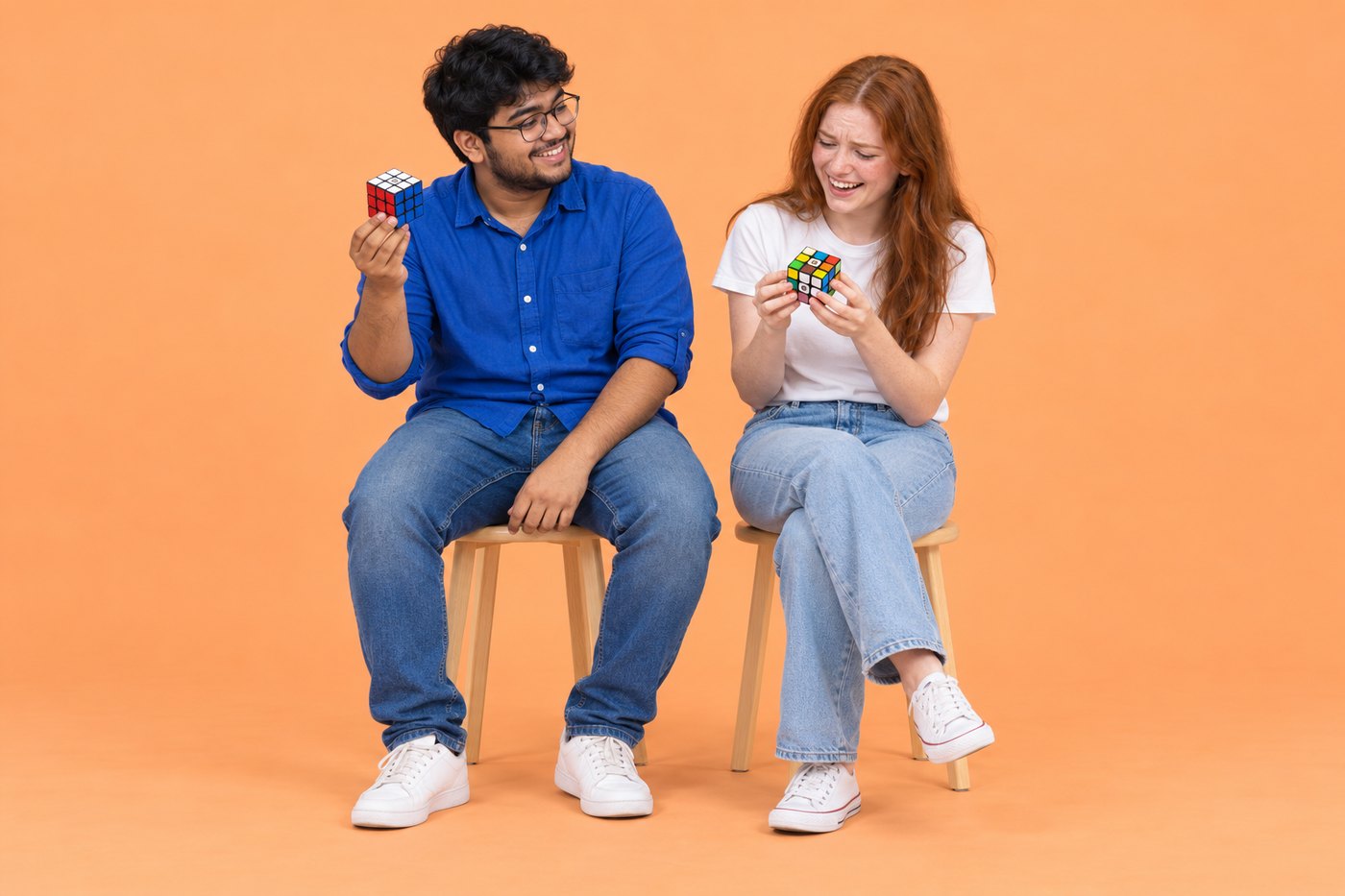
That is the story of Thomas, a 15-year-old from Ingleby Barwick, in the north of England. He got some Rubik's Cubes as a Christmas present. A Rubik's Cube is a puzzle that you solve by twisting it. The cube was invented by Erno Rubik in 1974, and at least 350 million have been sold.
Thomas learned to solve the cube from a family friend. Soon he started going to competitions. Now he solves a normal cube in about nine seconds, on average. That is his own skill after lots of practice, not what every learner can expect. He also competes in a different puzzle called the clock. In May 2026, he was the sixth fastest in the UK for the clock.
But Thomas says that speed is not the main reason he likes cubing. He says he mostly enjoys the social side. He says everyone at a competition speaks the same cube language, and they all get on well.
His mother, Louise Allinson, runs a Rubik's Cube club at the local library with him. She says that competitions have given Thomas confidence and social skills. She also says that the people at the events are very supportive. Children do want to win, she says, but everyone is happy for whoever wins.
In May 2026, Allinson helped to arrange a cube competition in Darlington, with more than 60 competitors from all over the UK. It was the first one in their area. So do you need to be the best to belong to a hobby group? Thomas's story suggests that you do not. What helps a beginner feel welcome on their first visit to a club?
Intermediate version
Imagine you are given a puzzle that you can only solve alone. At first, you spend hours twisting it and failing. Then someone shows you a method, you improve, and one day you find that other people love the same thing. How does that change the puzzle?
That is roughly what happened to Thomas, a 15-year-old from Ingleby Barwick, near Stockton-on-Tees, in England, according to a BBC report published on 16 May 2026. He first became interested when he was given some Rubik's Cubes as a Christmas present. The cube, a puzzle solved by twisting, was invented by Erno Rubik in 1974, and at least 350 million have been sold worldwide.
Thomas learned from a family friend and soon began going to competitions. He now averages about nine seconds on a standard 3x3 cube. His main event, though, is a different puzzle called the clock, in which he was ranked sixth fastest in the UK at the time of the report. It is worth remembering that this ranking comes from May 2026, and that the clock and the standard cube are different events.
What stands out in the report is that he does not describe speed as the main attraction. He says it is mainly the social side that he enjoys, and that everyone at a competition speaks the same cube language and gets on well.
His mother, Louise Allinson, runs a Rubik's Cube club at their local library with him. She says that going to competitions has given Thomas confidence and social skills, and that the community is a wonderful and supportive one. She adds that children want to win, but that everyone is happy for whoever does.
Allinson also helped to arrange for the UK Cube Association to hold a competition at the Hopetown Railway Museum in Darlington on 16 and 17 May 2026. More than 60 competitors from around the UK were due to take part, and she described it as the first competition on Teesside.
These are the views of Thomas and his mother, not a study. They do not show that puzzles improve everyone's social skills, and a club is not a guarantee of friendship. But the story does show how a solitary activity can become a reason to meet people: you exchange techniques, you improve together, and you are happy when someone else gets a fast time.
Would you join a hobby group before you were good at the hobby? What would make you want to come back after your first visit?
Advanced version
Thomas can solve a standard Rubik's Cube in about nine seconds, but speed is not his favourite part of cubing. In a May 2026 BBC report, the 15-year-old described the people he met at competitions. The puzzle gave him something to practise alone and a reason to join a room full of others.
The cube was invented by Erno Rubik in 1974, and at least 350 million have been sold worldwide. Thomas began cubing when he was given some as a Christmas present, learned from a family friend and soon started attending competitions. At the time of the May 2026 report, he averaged about nine seconds on a standard 3x3 cube. His main event is a different puzzle called the clock, in which he was ranked sixth fastest in the UK in May 2026. The two events are separate.
It is striking how he describes the appeal. He says it is mainly the social side that he enjoys, and that everyone at a competition speaks the same cube language and gets on well. A shared language is one of the quickest ways to turn a room of strangers into a group.
His mother, Louise Allinson, runs a Rubik's Cube club at their local library with him. She says that going to competitions has given Thomas confidence and social skills, and she describes the community as wonderful and supportive. She also makes an honest point about competitions: children want to win, she says, but everyone is happy for whoever does.
Allinson helped to arrange for the UK Cube Association to hold a competition at the Hopetown Railway Museum in Darlington on 16 and 17 May 2026. More than 60 competitors from around the UK were due to take part, and she described it as the first such event on Teesside. A library club, a local competition and a clear first step all make a hobby easier to join.
It is important to read the report carefully. The comments come from Thomas and his mother, not from a study, so they do not show that puzzles improve everyone's social skills or that every club is as welcoming as this one. They do show a hobby in which competition and kindness exist at the same time, which is not what people always expect.
That is the interesting part. We tend to think that competition makes people rivals, and that friendship needs a break from competing. In this community, the opposite seems to be true: improving together, comparing times and cheering for the winner are all part of the same activity. Perhaps a good hobby community is one where you can join before you are good, and where the person who beats you is glad to explain how.
Would you enter a competition for the people instead of the prize? What would a club have to do to make you return after your first visit?
Study this story
Save the words you want to keep, talk about the story, then practise the language.
Highlights0 saved
Highlights0 saved
Highlights0 saved
Talk about it3 questions
- Would meeting other fans change how much you enjoyed a hobby?
- Which matters more at a hobby event: doing well or feeling welcome?
- What could a school do for students whose interests are not very common?
Sentence help (optional): I think ... because ... · One reason is ... · For me, ...
You can talk about people in general instead of yourself, and you can pass on any question.
Talk about it3 questions
- Would meeting other fans change how much you enjoyed a hobby?
- Which matters more at a hobby event: doing well or feeling welcome?
- What could a school do for students whose interests are not very common?
You can talk about people in general instead of yourself, and you can pass on any question.
Try it
Plan the first ten minutes of a welcoming first session for an invented puzzle or hobby club. Include an easy first task that anyone can do, one way for a beginner to ask for help, and a small role for the newest person, such as keeping time or choosing the next puzzle. Then explain what an experienced member should say and not say. A Rubik's Cube is not required, and nobody has to speak about their own hobby, school or personal life unless they want to.
Exercises4 exercises
1. Complete the sentences
Drag a word into each gap, or tap a word and then tap a gap. Tap a filled gap to put the word back. Two words are not needed.
- A Rubik's Cube is a puzzle that you solve by it.
- Thomas learned to solve the cube from a family .
- That is his own skill after lots of , not what every learner can expect.
- He says he mostly enjoys the side.
- Louise Allinson runs a cube at the local library.
2. Match the meaning
Choose the meaning of each word or phrase as it is used in the article.
- puzzle
- confidence
- supportive
- competitions
Write the letter of the meaning next to each word.
- A helpful and encouraging to other people
- B events in which people try to win
- C a feeling that you can do something well
- D a game or toy that you try to solve
3. Put the verb in the right form
Write the correct form of the verb in brackets.
- One Christmas, Thomas some Rubik's Cubes as a present. (get)
- Soon he going to competitions. (start)
- Now he a normal cube in about nine seconds. (solve)
- The cube invented by Erno Rubik in 1974. (be)
- Competitions have Thomas confidence, his mother says. (give)
4. True, false or not given
Choose Not given if the article does not say, even when you think the statement is probably true.
- Thomas received some cubes as a Christmas present.
The text says: "He got some Rubik's Cubes as a Christmas present."
- A normal cube takes Thomas about nine minutes on average.
The text says the opposite: "in about nine seconds, on average"
- Erno Rubik invented the cube while he was at university.
Not stated. The text does not say where Erno Rubik was when he invented the cube.
- Thomas helps his mother with a Rubik's Cube group at a library.
The text says: "runs a Rubik's Cube club at the local library with him"
- The Darlington event had fewer than ten competitors.
The text says the opposite: "with more than 60 competitors"
Your score
Do all four, then add them up.
Answer key
- Complete the sentences1 twisting · 2 friend · 3 practice · 4 social · 5 club
- Match the meaning1 puzzle = D · 2 confidence = C · 3 supportive = A · 4 competitions = B
- Put the verb in the right form1 got · 2 started · 3 solves · 4 was · 5 given
- True, false or not given1 True · 2 False · 3 Not given · 4 True · 5 False
1. Complete the sentences
Drag a word into each gap, or tap a word and then tap a gap. Tap a filled gap to put the word back. Two words are not needed.
- A Rubik's Cube is a puzzle that is solved by .
- Thomas now about nine seconds on a standard cube.
- The clock and the standard cube are different .
- She says that the community is a wonderful and one.
- These are the views of Thomas and his mother, not a .
2. Match the meaning
Choose the meaning of each word or phrase as it is used in the article.
- ranked
- solitary
- community
- guarantee
Write the letter of the meaning next to each word.
- A done or experienced alone, without other people
- B given a place in a list according to how fast or good someone is
- C a promise that something will definitely happen
- D a group of people who share an interest
3. Put the verb in the right form
Write the correct form of the verb in brackets.
- Thomas learned from a family friend and soon going to competitions. (begin)
- He interested when he was given some cubes. (become)
- Louise Allinson a club at the library. (run)
- The report was on 16 May 2026. (publish)
- She adds that children to win, but that everyone is happy for whoever does. (want)
4. True, false or not given
Choose Not given if the article does not say, even when you think the statement is probably true.
- On a standard cube, Thomas's typical time is about nine seconds.
The text says: "He now averages about nine seconds on a standard 3x3 cube"
- Thomas's main event is the standard 3x3 cube.
The text says the opposite: "His main event, though, is a different puzzle called the clock"
- Erno Rubik still works on puzzles today.
Not stated. The text does not say what Erno Rubik does now.
- A competition was arranged at a railway museum in Darlington.
The text says: "to hold a competition at the Hopetown Railway Museum in Darlington"
- The text says the report proves puzzles improve social skills.
The text says the opposite: "They do not show that puzzles improve everyone's social skills"
Your score
Do all four, then add them up.
Answer key
- Complete the sentences1 twisting · 2 averages · 3 events · 4 supportive · 5 study
- Match the meaning1 ranked = B · 2 solitary = A · 3 community = D · 4 guarantee = C
- Put the verb in the right form1 began · 2 became · 3 runs · 4 published · 5 want
- True, false or not given1 True · 2 False · 3 Not given · 4 True · 5 False
1. Complete the sentences
Drag a word into each gap, or tap a word and then tap a gap. Tap a filled gap to put the word back. Two words are not needed.
- It is how he describes the appeal of cubing.
- A shared language is one of the quickest ways to turn a room of into a group.
- The comments come from Thomas and his mother, not from a .
- In this community, the seems to be true: people improve together and cheer for the winner.
- Improving together, comparing times and cheering for the winner are all part of the same .
2. Match the meaning
Choose the meaning of each word or phrase as it is used in the article.
- rivals
- appeal
- welcoming
- supportive
Write the letter of the meaning next to each word.
- A the quality that makes something attractive or interesting
- B friendly to new people
- C helpful and encouraging to other people
- D people or groups who compete against each other
3. Make the right word
Use the word in brackets to make a word that fits the gap.
- He says it is mainly the side that he enjoys. (SOCIETY)
- A library club and a local make a hobby easier to join. (COMPETE)
- Going to competitions has given Thomas . (CONFIDENT)
- We tend to think that competing makes people rivals, and that needs a break from competing. (FRIEND)
- They show a hobby in which people compete and still show . (KIND)
4. True, false or not given
Choose Not given if the article does not say, even when you think the statement is probably true.
- In May 2026, five people in the UK were faster than Thomas at the clock.
The text says: "ranked sixth fastest in the UK in May 2026"
- Thomas's main event is the standard cube.
The text says the opposite: "his main event is a different puzzle called the clock"
- The UK Cube Association has more than 1,000 members.
Not stated. The text does not say how many members the UK Cube Association has.
- More than 60 cubers were expected at the Darlington event.
The text says: "More than 60 competitors from around the UK were due to take part"
- The text says the report proves that puzzles improve everyone's ability to get on with others.
The text says the opposite: "they do not show that puzzles improve everyone's social skills"
Your score
Do all four, then add them up.
Answer key
- Complete the sentences1 striking · 2 strangers · 3 study · 4 opposite · 5 activity
- Match the meaning1 rivals = D · 2 appeal = A · 3 welcoming = B · 4 supportive = C
- Make the right word1 social · 2 competition · 3 confidence · 4 friendship · 5 kindness
- True, false or not given1 True · 2 False · 3 Not given · 4 True · 5 False
Continue reading
Sport
Gilberto Mora: A World Cup Debut at 17
A 17-year-old midfielder played for Mexico at the World Cup. His coach and a teammate explain what makes him stand out, and what it takes to be the youngest in the team.
Hobbies
The School Sketch That Led to a Book
A 15-year-old drew the author who was visiting her school. The portrait led to a published book.
Science & making
The Teen Who Turned Paper Folding into Research
A 17-year-old from Japan won a top science prize for studying how folded shapes move, starting from a ladybird's wing.

Read this article online: johnplusnews.com/articles/the-teen-who-found-his-people-through-a-puzzle/