Were Children Making Art Thousands of Years Ago?
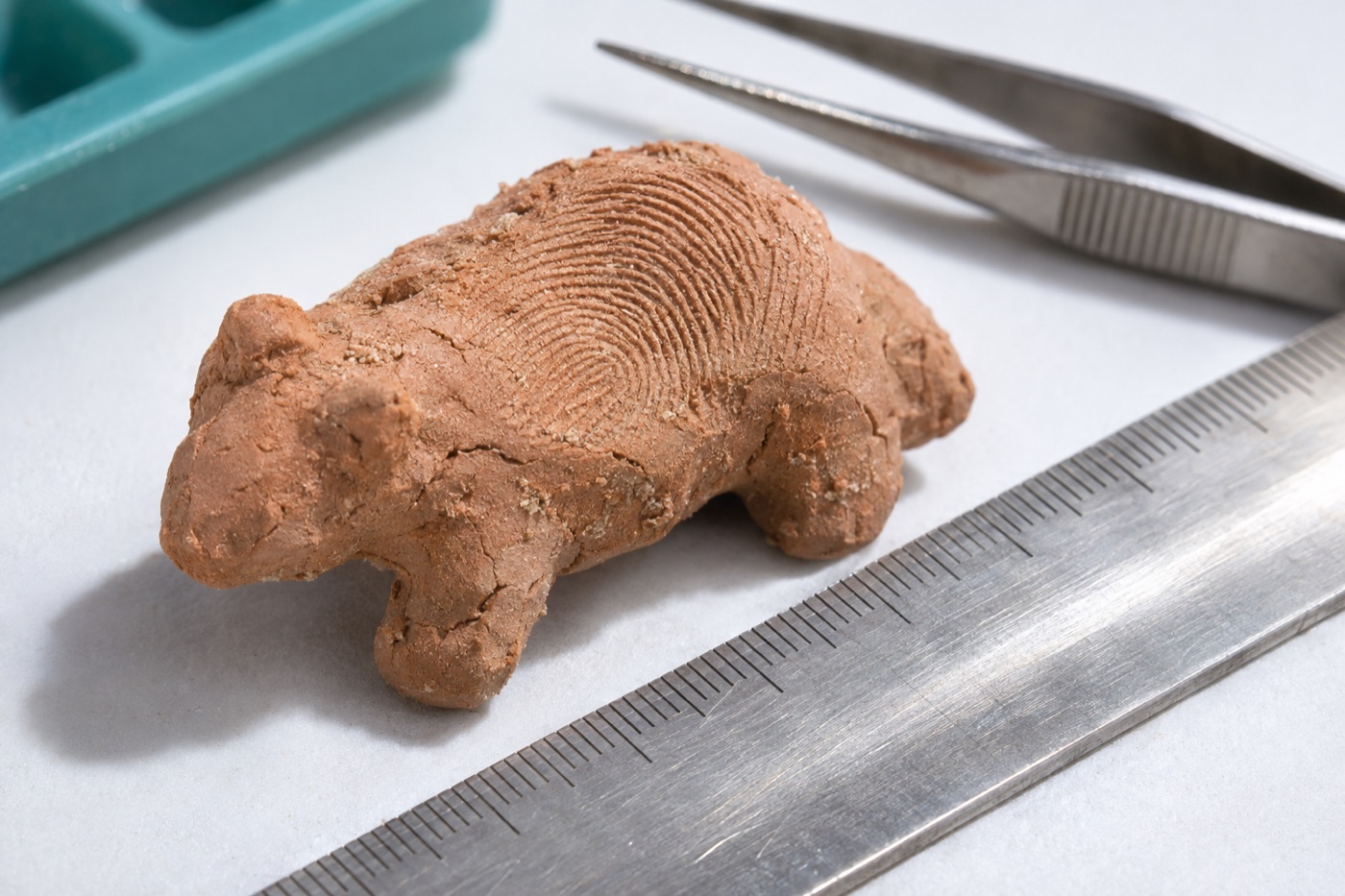
Archaeologists studied tiny clay figures from three sites in Israel and found fingerprints from adults and children. The fingerprints show children took part in shaping the clay, but why they did it is still a question.
Warm up3 questions
- Where do you learn most of the things you can do?
- Do you like making things with your hands?
- Is making something always art, or does it need a reason?
Sentence help (optional): I'd choose ... because ... · For me, ... · I think ... because ...
Warm up3 questions
- Where do you learn most of the things you can do?
- Do you like making things with your hands?
- Is making something always art, or does it need a reason?
Warm up3 questions
- Where do you learn most of the things you can do?
- Do you like making things with your hands?
- Is making something always art, or does it need a reason?
Core version
Imagine finding a tiny clay bird that is thousands of years old. Now imagine that, pressed into the clay, there is a fingerprint left by a child. In November 2026, researchers published a study about objects like this, found at three sites in Israel.
The makers were the Natufians. They lived in some of the first villages, before farming began, and found food by hunting and collecting plants. A team led by Laurent Davin, from the Hebrew University of Jerusalem, studied 154 small clay objects from three Natufian sites. The objects are between about 11,650 and 15,000 years old. They include 15 figurines, most of them shaped like birds. Some pieces may show animals such as a gazelle, and some seem to show people. The authors say this is the earliest clay-figure tradition known in this part of the world.
How can anyone know who made them? The team looked at fingerprints. The lines on a child's fingers are closer together than the lines on an adult's. By measuring them and comparing them with prints from modern people who shaped clay, the researchers could estimate the age of the person who left each mark. Some prints came from adults, and some came from children.
One figure shaped like a person is especially interesting. It has the print of a young adult, and a child's print partly covers it. The researchers think that an adult may have passed the figure to a child while the clay was still wet. That is their interpretation. The fingerprints show who touched the clay, but they cannot show why. It could be a way of teaching, or play, or both.
There are limits. This is a preliminary study. Most of the pieces are broken, and only two are complete. The team has not yet found out where the clay came from or how it was hardened, and they have not worked out what the red colour is. We also cannot say that anyone gave an art lesson.
Even so, the children did leave their mark. It may be one piece of the puzzle about how people in the first villages learned the ropes of making things. Where do you pick up your skills, by watching, copying or being told?
Intermediate version
Imagine finding a tiny clay bird thousands of years old, with a child's fingerprint pressed into it. In November 2026, researchers published a study in the journal PLOS One about objects like this, found at three sites in Israel. The question behind the story is a simple one: were children taking part when people first began making clay figures?
The makers were the Natufians, who lived in some of the first villages, before farming, and found food by hunting and gathering. A team led by Laurent Davin, from the Hebrew University of Jerusalem, studied 154 small clay objects from three Natufian sites. The objects date from about 15,000 to 11,650 years ago. They include 15 figurines, most of them shaped like birds, while others seem to show animals or people. One fragment may show a gazelle's face, and some pieces keep traces of a red colour. The authors say it is the earliest clay figure tradition known in Southwest Asia, which suggests that such objects did not appear only with farming.
To find out who made the objects, the team studied the fingerprints left in the clay. The ridges on children's fingers are narrower than those on adults. By measuring the ridges and comparing them with prints from modern people who shaped clay, the researchers estimated the age of the people who left each mark. The results suggest that both adults and children handled the clay.
One human-shaped figure stands out. It carries the print of a young adult, and the print of a child partly covers it. The authors think this may show an adult passing the figure to a child while the clay was still wet, and they describe it as a possible rare sign of knowledge being passed on through hands-on learning. That is an interpretation. A fingerprint shows who touched the clay, not why.
The study also has limits. The authors call it preliminary. Only two of the objects are complete, and the rest are fragments. Age estimates depend on a comparison with modern fingerprints, and the team has not yet worked out where the clay came from, how it was hardened or what the red colour is. We cannot say that children were taught art, or that they were playing. Both are possible.
Still, the children did leave their mark. The prints suggest that children shaped, and even coloured, some objects, and the authors suggest that adults may have guided them. Perhaps this is one piece of the puzzle about how skills were passed on in the first villages. After all, children have to learn the ropes somewhere, and most of us still pick up skills by watching others.
What skill did you learn by watching somebody else, and who was your teacher?
Advanced version
Archaeology usually deals with things that are broken, buried and silent, so it is unusual when it offers something as personal as a fingerprint. In November 2026, a team led by Laurent Davin, from the Hebrew University of Jerusalem, published a study in PLOS One of 154 small clay objects from three Natufian sites in Israel. The Natufians lived in some of the earliest villages, before agriculture, and the objects date from roughly 15,000 to 11,650 years ago.
The collection includes 15 figurines, most of them bird-shaped, together with others that appear to show animals and people. One fragment may represent a gazelle's face, and some pieces keep traces of red colouring. The authors argue that this is the earliest clay figurative tradition yet known in Southwest Asia, which challenges the idea that such clay objects became common only with Neolithic farming. Davin says the finds change how we understand the beginnings of artistic expression in the first villages.
The most original part of the study is its method. The ridges on a child's fingertips are narrower than those on an adult's, so the researchers measured the ridge breadth in prints left in the clay and compared it with prints from modern people who had shaped clay. That allowed them to estimate the age of the person behind each mark. The results suggest that children and adults both took part, and that the children were not simply watching. Their prints appear in the shaping of the objects and, in one case, in a red residue that was smoothed by a child's finger.
One human-shaped figure carries the print of a young adult, partly covered by the print of a child. The authors read this as an adult passing the figure to a child while the clay was wet, which they call a possible rare sign of knowledge passed on through hands-on learning. They also suggest that children who made the bird figures were probably guided by an adult tradition. These are interpretations. A fingerprint records who touched the clay and in what order, but it cannot reveal intention.
The limits are considerable, and the authors acknowledge many of them. The study is described as preliminary. Only two of the objects are complete, so identifications rely partly on comparison with other finds. The origin of the clay, the way it was hardened and the nature of the red pigment have not yet been worked out, and age estimates rest on a comparison with modern fingerprints. Nobody can say whether the children were playing, practising a craft or learning beliefs, and phrases such as art lessons would read too much into the evidence.
None of this makes the finding trivial. It adds one piece of the puzzle to a larger picture in which skills, symbols and knowledge were handed down across generations in the first villages. The children left their mark, literally, and the careful response is neither to dismiss it nor to invent a classroom around it. Which of your own skills did you learn by watching, and how would an archaeologist ever know?
Study this story
Save the words you want to keep, talk about the story, then practise the language.
Highlights0 saved
Highlights0 saved
Highlights0 saved
Talk about it3 questions
- What can a fingerprint tell us, and what can it not tell us?
- Why do scientists say that this is their interpretation?
- What would you like to ask a child who lived in a Natufian village?
Sentence help (optional): I think ... because ... · One reason is ... · For me, ...
You can talk about people in general instead of yourself, and you can pass on any question.
Talk about it3 questions
- What can a fingerprint tell us, and what can it not tell us?
- Why do scientists say that this is their interpretation?
- What would you like to ask a child who lived in a Natufian village?
You can talk about people in general instead of yourself, and you can pass on any question.
Try it
Work with a partner. Imagine you are archaeologists and you have found a small clay object with two different fingerprints on it. On paper, write down three things you can say for certain, and three things you can only guess. Then compare your lists with another pair and decide which guess you would most like to test. No clay, real fingerprints or photos are needed, and nobody has to share anything personal.
Exercises4 exercises
1. Complete the sentences
Drag a word into each gap, or tap a word and then tap a gap. Tap a filled gap to put the word back. Two words are not needed.
- The team studied 154 small clay from three Natufian sites.
- The collection includes 15 figurines, most of them shaped like .
- The lines on a child's fingers are closer than the lines on an adult's.
- Most of the pieces are broken, and only two are .
- The Natufians found food by hunting and collecting .
2. Match the meaning
Choose the meaning of each word or phrase as it is used in the article.
- figurines
- interpretation
- preliminary
- fingerprint
Write the letter of the meaning next to each word.
- A an idea about what something means
- B small statues of people or animals
- C early, before the full work is finished
- D the mark left by the tip of a finger
3. Put the verb in the right form
Write the correct form of the verb in brackets.
- A team by Laurent Davin studied 154 small clay objects. (lead)
- The team at fingerprints. (look)
- Some prints from adults. (come)
- The Natufians in some of the first villages. (live)
- The researchers that an adult may have passed the figure to a child. (think)
4. True, false or not given
Choose Not given if the article does not say, even when you think the statement is probably true.
- The team studied 154 clay objects.
The text says: "studied 154 small clay objects from three Natufian sites"
- All the clay objects are complete.
The text says: "Most of the pieces are broken, and only two are complete"
- The study found fingerprints from more than ten children.
The text does not give this information.
- The idea that an adult passed the figure to a child is only the researchers' interpretation.
The text says: "That is their interpretation"
- The text says that someone gave an art lesson.
The text says: "We also cannot say that anyone gave an art lesson"
Your score
Do all four, then add them up.
Answer key
- Complete the sentences1 objects · 2 birds · 3 together · 4 complete · 5 plants
- Match the meaning1 figurines = B · 2 interpretation = A · 3 preliminary = C · 4 fingerprint = D
- Put the verb in the right form1 led · 2 looked · 3 came · 4 lived · 5 think
- True, false or not given1 True · 2 False · 3 Not given · 4 True · 5 False
1. Complete the sentences
Drag a word into each gap, or tap a word and then tap a gap. Tap a filled gap to put the word back. Two words are not needed.
- The objects date from about 15,000 to 11,650 years .
- The ridges on children's fingers are than those on adults.
- The results suggest that both adults and children the clay.
- A fingerprint shows who touched the clay, not .
- Only two of the objects are complete, and the rest are .
- One fragment may show a gazelle's .
2. Match the meaning
Choose the meaning of each word or phrase as it is used in the article.
- traces
- ridges
- interpretation
- preliminary
Write the letter of the meaning next to each word.
- A raised lines, such as the lines on a fingertip
- B an idea about what something means
- C early, before the full work has been done
- D small signs that something was there
3. Put the verb in the right form
Write the correct form of the verb in brackets.
- The team the fingerprints left in the clay. (study)
- The researchers the age of the people who left each mark. (estimate)
- The authors it preliminary. (call)
- The print of a child partly it. (cover)
- The Natufians in some of the first villages. (live)
4. True, false or not given
Choose Not given if the article does not say, even when you think the statement is probably true.
- Both adults and children handled the clay, according to the results.
The text says: "The results suggest that both adults and children handled the clay"
- A fingerprint tells us why someone touched the clay.
The text says: "A fingerprint shows who touched the clay, not why"
- The text gives the height of the children.
The text does not give this information.
- Only two of the objects are complete.
The text says: "Only two of the objects are complete, and the rest are fragments"
- The text says that children were definitely taught art.
The text says: "We cannot say that children were taught art, or that they were playing"
Your score
Do all four, then add them up.
Answer key
- Complete the sentences1 ago · 2 narrower · 3 handled · 4 why · 5 fragments · 6 face
- Match the meaning1 traces = D · 2 ridges = A · 3 interpretation = B · 4 preliminary = C
- Put the verb in the right form1 studied · 2 estimated · 3 call · 4 covers · 5 lived
- True, false or not given1 True · 2 False · 3 Not given · 4 True · 5 False
1. Complete the sentences
Drag a word into each gap, or tap a word and then tap a gap. Tap a filled gap to put the word back. Two words are not needed.
- The Natufians lived in some of the earliest villages, before .
- The ridges on a child's fingertips are than those on an adult's.
- The results suggest that the children were not simply .
- A fingerprint records who touched the clay, but it cannot reveal .
- The study is described as .
- Only two of the objects are .
2. Match the meaning
Choose the meaning of each word or phrase as it is used in the article.
- figurative
- acknowledge
- residue
- trivial
Write the letter of the meaning next to each word.
- A a small amount of something left behind
- B to accept that something is true
- C showing real things, such as animals or people, in a shape or picture
- D of little importance
3. Make the right word
Use the word in brackets to make a word that fits the gap.
- The most part of the study is its method. (ORIGIN)
- The limits are , and the authors acknowledge many of them. (CONSIDER)
- A fingerprint cannot reveal . (INTEND)
- The Natufians lived in some of the villages. (EARLY)
- It is unusual when archaeology offers something as as a fingerprint. (PERSON)
4. True, false or not given
Choose Not given if the article does not say, even when you think the statement is probably true.
- The study looked at 154 small clay objects.
The text says: "published a study in PLOS One of 154 small clay objects from three Natufian sites in Israel"
- Only adults left fingerprints in the clay.
The text says: "children and adults both took part"
- The text says exactly how many fingerprints were measured.
The text does not give this information.
- The authors describe the study as preliminary.
The text says: "The study is described as preliminary"
- The text says it is certain that the children were learning beliefs.
The text says: "Nobody can say whether the children were playing, practising a craft or learning beliefs"
Your score
Do all four, then add them up.
Answer key
- Complete the sentences1 agriculture · 2 narrower · 3 watching · 4 intention · 5 preliminary · 6 complete
- Match the meaning1 figurative = C · 2 acknowledge = B · 3 residue = A · 4 trivial = D
- Make the right word1 original · 2 considerable · 3 intention · 4 earliest · 5 personal
- True, false or not given1 True · 2 False · 3 Not given · 4 True · 5 False
Continue reading
Science & making
Can Dogs Smell When People Are Stressed?
Researchers tested whether the smell of a stressed person changes how dogs behave. The result is interesting, but it is smaller than the headlines might suggest.
Science & making
Could You Build a Satellite That Fits in a Can?
Teams of students aged 14 to 19 build a model satellite the size of a drinks can. It never reaches space, but it still has to do real science.
TV, film & fandom
Jenna Ortega Made Wednesday's Dance Her Own
A famous dance scene in a Netflix series was not planned by a choreographer. The actor made it up herself, and credited the performers who inspired her.


Read this article online: johnplusnews.com/articles/were-children-making-art-thousands-of-years-ago/