News lesson24 March 2026
Why a Balcony View Can Cost Thousands
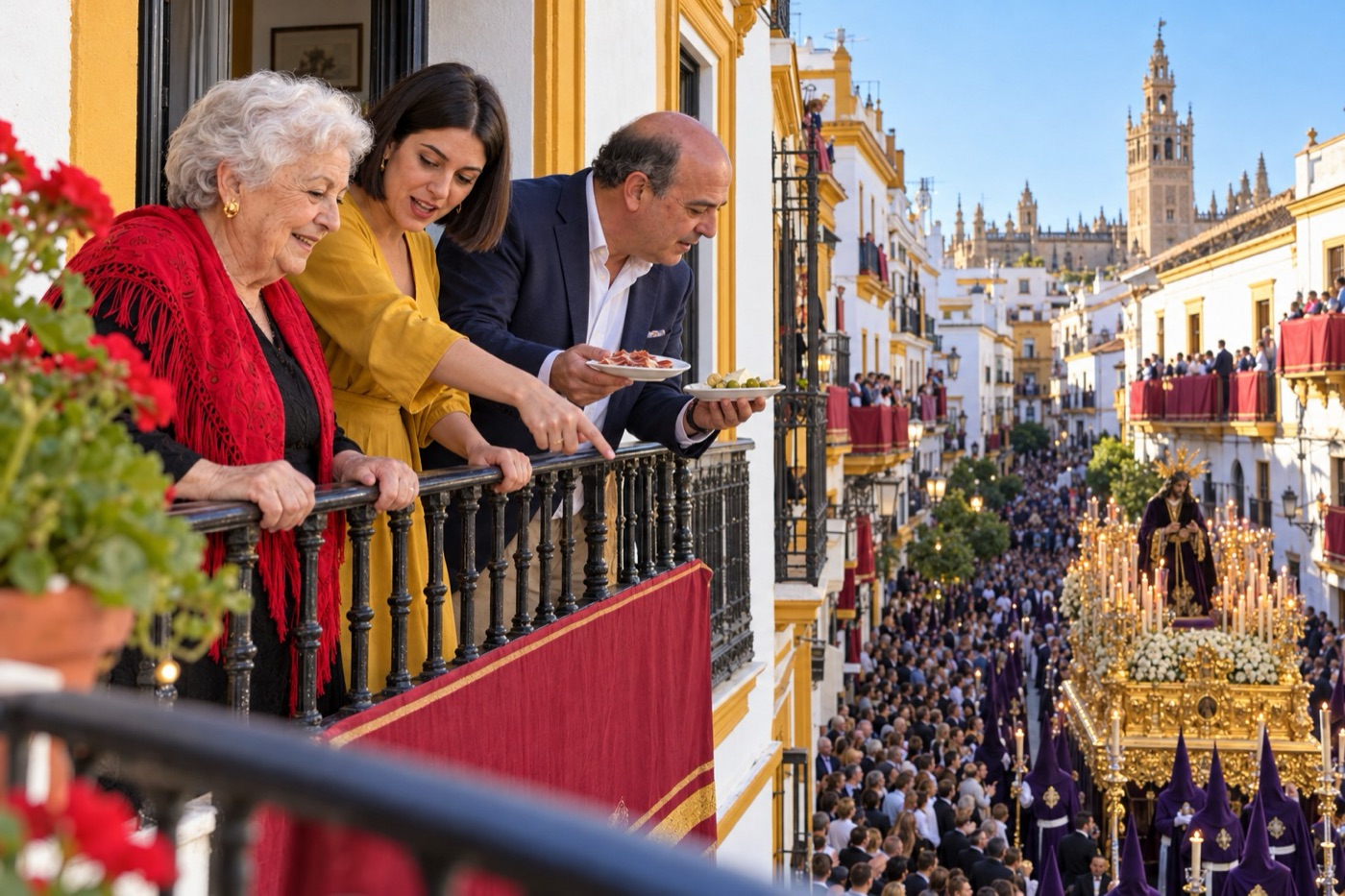
In March 2026, central balconies along Seville's Holy Week route averaged around €6,000 for the week, with some packages near €9,000.
Before you read
1Warm up3 questions
Talk about these questions with a partner.
- What would you pay for a perfect view of a special event?
- Would you rather be close to the action or comfortable nearby?
- When can an event start to feel more for visitors than local people?
2Key words8 words
These words are in the article. Choose the letter of the meaning for each one.
- average
- property
- customers
- product
- processions
- decorated
- desirable
- gather
- Acome together in one place
- Bgroups of people walking slowly together in a line
- Csomething that many people want to have
- Dthe usual amount, not very high and not very low
- Ea building or land that someone owns
- Fpeople who buy things or pay for a service
- Gmade to look nice with extra things
- Hsomething that people make and sell
1Warm up3 questions
Talk about these questions with a partner.
- What would you pay for a perfect view of a special event?
- Would you rather be close to the action or comfortable nearby?
- When can an event start to feel more for visitors than local people?
2Key words8 words
These words are in the article. Choose the letter of the meaning for each one.
- brotherhoods
- spectators
- exclusivity
- uninterrupted
- critics
- commercial
- extraordinary
- unequal
- Agroups of men who share the same religion or aims
- Bnot the same for everyone, not fair
- Cpeople who watch an event
- Dcontinuous, with nothing in the way
- Ebeing only for a small, special group of people
- Fpeople who say what is wrong with something
- Gvery unusual or surprising
- Hconnected with buying and selling to make money
1Warm up3 questions
Talk about these questions with a partner.
- What would you pay for a perfect view of a special event?
- Would you rather be close to the action or comfortable nearby?
- When can an event start to feel more for visitors than local people?
2Key words8 words
These words are in the article. Choose the letter of the meaning for each one.
- civic
- hospitality
- exclusivity
- inheritance
- brotherhoods
- authentic
- sustain
- register
- Areal and true, not copied
- Bconnected with a town or city and its people
- Cgroups of men who share a religion or purpose
- Dbe noticed or felt
- Ekeep something going over time
- Fhotels, restaurants and other businesses that look after guests
- Gsomething valuable passed down from earlier generations
- Hthe quality of being only for a few rich or special people
Read
3Read the article
The paragraphs are numbered. Look out for the key words from task 2.
Core version
Imagine paying €9,000 to watch people walking through the streets. It sounds impossible, but during Holy Week in Seville, Spain, some of the best balconies cost almost that much to rent for the celebrations.
Holy Week, known in Spanish as Semana Santa, is the biggest event of the year in Seville. Religious groups carry large decorated images through the streets, and crowds gather to watch them pass. Some people come because of their faith. Others come for the music, the history and the atmosphere.
The streets fill up early and can become extremely crowded. A balcony above the main route gives you a clear, comfortable view without standing for hours among other people. Some property owners rent out these spaces to visitors, and special packages may include food and drinks, which makes the experience even more expensive.
In March 2026, local property professionals reported that central balconies were renting for an average of around €6,000 for the whole week. Particularly desirable places, sometimes with catering included, could reach almost €9,000. These are prices for the week, not the price of standing outside for a few minutes, and the highest figures were for particular locations or packages, not for every balcony.
Some people say that owners should be free to rent their property for whatever customers will pay. A balcony is private, nobody has to take the offer, and owners have every right to make a profit from a space they already own.
Others worry that an important religious and cultural tradition is turning into an expensive product. They fear that ordinary residents will be pushed away from the best places in their own city, and that the celebration will slowly start to feel like a show for visitors.
Of course, people can still watch many processions from the public streets without paying anything. But crowds, limited space and long waits make the experience very different. Arriving three hours early to stand behind a wall of people is not the same as sitting down with a good view and a plate of food.
So the story raises an interesting question. Should the best seats in the house at a shared tradition always go to the person who can pay the most?
Intermediate version
Seville's Holy Week processions are among Spain's most recognisable cultural traditions. Thousands of people fill the streets to watch religious brotherhoods carry elaborate images through the historic centre. Yet in 2026, the headlines about the celebrations focused on something far more commercial: the extraordinary cost of renting a balcony overlooking the route.
According to information released by Seville's property administrators in March 2026, the average price for a centrally located balcony during the week had reached around €6,000. Premium positions along the main procession route, especially with food and drink included, could approach €9,000. The figures referred to packages covering the celebrations, not an ordinary ticket for a single procession.
The attraction is obvious. The streets become packed with spectators, while a balcony offers a comfortable and uninterrupted view. Owners can earn substantial sums from space that would otherwise be used privately, and the best positions are snapped up well in advance. Businesses can turn the experience into a package aimed at visitors who are willing to pay for convenience and exclusivity.
For a visitor who can afford it, the appeal is easy to understand. Holy Week in Seville can mean long waits, blocked streets and very little chance of a clear view, and a balcony removes all of that at a stroke. The price buys certainty as much as comfort.
But rising prices have started an argument about the purpose of a public tradition. Holy Week is rooted in local religious communities, and its ceremonies have been handed down through a history much older than the modern tourism industry. Critics fear that commercial competition is pricing local families out of an event that helps define their city.
Supporters reply that the processions remain visible from public streets and that privately owned balconies are not public property. Demand is high, space is limited and nobody is obliged to rent a premium position. From that perspective, the prices simply reflect what customers are prepared to pay.
It is also worth remembering who the money reaches. Balcony rentals benefit the households and businesses that happen to own property on the right streets, which is a narrow group compared with the many families who take part in the processions themselves. Good fortune in the property market is not the same as a contribution to the tradition.
The disagreement is familiar in tourist cities everywhere. Visitors may be willing to spend far more than residents. Access to the most convenient places can then become unequal, and the best of anything can drift out of reach of the people who live there. Seville's expensive balconies ask where to draw the line between making money from culture and making culture less welcoming to the people who sustain it.
Advanced version
A balcony above Seville's Holy Week processions can offer a remarkable view, and an equally remarkable bill. Reports in March 2026 put central balcony rentals at about €6,000 for the week, with some packages approaching €9,000. The processions take place in public streets. The best place to watch may be privately priced.
Holy Week combines religious devotion, civic identity and centuries-old tradition, and the processions attract enormous crowds. The supply of balconies overlooking the central route is fixed and cannot be expanded, so property owners and hospitality businesses can sell comfort, exclusivity and an unusually close view of ceremonies that most spectators watch from packed streets.
What the going rate reveals, in other words, is scarcity rather than quality. The balcony itself has not improved; the number of people competing for it has risen. This is the familiar logic of any tourist city in which demand grows faster than the physical space available to accommodate it.
The cultural implications are less straightforward. A festival shaped by local religious brotherhoods now operates within a tourism economy where scarcity creates opportunities for profit. Residents may regard the ceremonies as a shared inheritance, while commercial operators see demand for a service that can legitimately be bought and sold.
Defenders of the market point out that the streets remain publicly accessible and that balcony owners are entitled to control private space. Critics respond that formal access is not always the same as meaningful access. If the finest vantage points are increasingly cashed in on by owners and taken by wealthy visitors, local participants may feel that a familiar tradition is being quietly repackaged for outsiders.
There is no simple division between authentic culture and commercial activity. Festivals have long supported hotels, restaurants and small businesses, and tourist spending can help sustain a local economy that sustains the festival in turn. The concern arises when financial incentives begin to shape how an event is experienced, discussed or organised, rather than merely supporting something that already exists.
Nor is the pressure purely financial. A balcony let to visitors is one that a local family may no longer watch from, and that loss could register socially long before it appears in any economic account of the week. Traditions are maintained largely by habit, and habits are fragile when the places that housed them change hands each spring.
Timing complicates the picture further. Once a tradition is valuable, pressure to protect its commercial appeal could give way to decisions no participant asked for: routes adjusted for visibility, schedules arranged around visitors, atmosphere managed rather than allowed to happen. Such changes are a concern, not something documented here, and none has to occur, but each step could look reasonable on its own.
Seville's balconies therefore offer a revealing example of a wider tension. Cultural traditions are powerful partly because they bring communities together, yet their very popularity can turn access into a scarce commodity and squeeze out the people for whom the occasion means most. The question is not whether an owner may charge for a view, but whether an increasingly commercial setting changes the meaning of what spectators have come to see.
After you read
4True, false or not given5 statements
Choose T (true), F (false) or NG (the article does not say).
- The city council has limited balcony rental prices.
Not stated. The text does not mention any city council rules on balcony prices.
- Holy Week is the biggest event of the year in Seville.
The text says: "Holy Week, known in Spanish as Semana Santa, is the biggest event of the year in Seville."
- Nobody can watch the processions without paying.
The text says the opposite: "people can still watch many processions from the public streets without paying anything."
- The quoted prices cover the whole week, not a single procession.
The text says: "These are prices for the week, not the price of standing outside for a few minutes."
- The writer says that every balcony costs about €9,000.
The text says the highest figures were "for particular locations or packages, not for every balcony".
5Vocabulary5 gaps
Complete the sentences with words from the box. Two words are not needed.
atmospherecateringcrowdfaithfestivalresidentsroute
- The old streets, the music and the candles gave the night a magical .
- Many of Seville cannot afford the best places in their own city.
- The price of the balcony includes , so you get lunch and drinks while you watch.
- Some people go to the processions because of their , not only for the show.
- We arrived early to get a good place on the the processions follow.
6Verb forms5 gaps
Write the correct form of the verb in brackets.
- Last spring, we for three hours behind a wall of people. (STAND)
- Holy Week as Semana Santa in Spanish. (KNOW)
- In March 2026, local professionals the average prices. (REPORT)
- Some fear the celebration is into a show for visitors. (TURN)
- People can still watch many processions without anything. (PAY)
7Language focuslinking words
Complete the sentences with words from the box. Two words are not needed. Some linking words show a contrast (although, however), some show a reason (because) and some show a result (so). Read the whole sentence before you choose.
althoughbecausedespitehoweverinsteadsotherefore
- the streets are free, many people wait for hours.
- Many owners rent out their balconies visitors will pay a lot.
- The streets are very crowded, some visitors pay for a balcony.
- Some people think owners can charge what they want. , others say the tradition belongs to everyone.
- Many families cannot pay for a balcony. of sitting down, they stand in the street.
4True, false or not given5 statements
Choose T (true), F (false) or NG (the article does not say).
- Seville's property administrators released the figures in March 2026.
The text says the figures were "released by Seville's property administrators in March 2026".
- Supporters argue that the processions can no longer be seen from the public streets.
The text says the opposite: "Supporters reply that the processions remain visible from public streets".
- The article suggests that balcony owners are a smaller group than the families who take part in the processions.
The text calls the owners "a narrow group compared with the many families who take part".
- Hotel prices in Seville rose by the same amount.
Not stated. The text does not mention hotel prices.
- The prices in the article are for a ticket to a single procession.
The text says the figures were for packages "not an ordinary ticket for a single procession".
5Vocabulary6 gaps
Complete the sentences with words from the box. Two words are not needed.
certaintyconvenienceelaborateexclusivityobligedoverlookingsubstantialsustain
- The company made a profit last year, far more than anyone had predicted.
- The costumes were so that each one took months to sew by hand.
- Under the new rules, shops are not to stay open on public holidays.
- Our hotel room has a lovely balcony the old market square.
- Buying a ticket in advance gives you the that you will get in.
- Tourism can a small town's economy by bringing in money all year round.
6Verb forms5 gaps
Write the correct form of the verb in brackets.
- By the time we reached the street, every balcony . (TAKE)
- If prices keep rising, local families able to afford a view. (NOT / BE)
- The processions by thousands of people every year. (WATCH)
- Critics say the tradition a lot over the last decade. (CHANGE)
- You to pay if you watch from the street. (NOT / NEED)
7Language focuslinking words
Complete the sentences with words from the box. Two words are not needed. Some linking words are followed by a noun (despite), some join two clauses (whereas, provided) and some start a new sentence (nevertheless, otherwise). Check the logic too.
consequentlydespiteneverthelessotherwiseprovidedunlesswhereas
- the high prices, most of the best balconies were booked weeks ahead.
- Residents often see the procession as a tradition, visitors may see it as a spectacle.
- Balcony rentals are expensive. , they sell out every year.
- Visitors can book a balcony they pay the full price in advance.
- Owners need to rent the space at a fair price. , local families will be pushed out.
4True, false or not given5 statements
Choose T (true), F (false) or NG (the article does not say).
- The writer implies that the high price of a balcony reflects competition for places rather than a better view.
The text says "The balcony itself has not improved; the number of people competing for it has risen."
- The final paragraph says owners should not be allowed to charge for a view.
The text says the opposite: "The question is not whether an owner may charge for a view".
- Most balcony owners are hospitality businesses rather than families.
Not stated. The text mentions "property owners and hospitality businesses" but gives no proportions.
- The writer suggests that the social cost of letting balconies to visitors may be noticed before the financial one.
The text says the loss "could register socially long before it appears in any economic account".
- The writer argues that tourist spending is always harmful to a festival.
The text says tourist spending "can help sustain a local economy that sustains the festival in turn".
5Vocabulary6 gaps
Complete the sentences with words from the box. Two words are not needed.
accommodateauthenticitycommodityfragileincentivesprestigerepackagedscarcity
- Oil is traded on world markets like any other .
- The of affordable housing in the city has pushed rents up year after year.
- The old stadium could not the crowds that came for the final.
- Tax encouraged the company to build its new headquarters in the region.
- Trust between neighbours is and can disappear after a single dispute.
- The old folk song was as a pop hit and sold millions.
6Word forms5 gaps
Use the word in brackets to make a word that fits the gap.
- The merger could have serious for thousands of employees. (IMPLY)
- The court ruled that the land had been acquired. (LEGITIMATE)
- A token apology is not a response to a serious complaint. (MEAN)
- Her to the cause lasted for more than fifty years. (DEVOTE)
- Smartphones have become central to how we organise our daily lives. (INCREASE)
7Language focuslinking words
Complete the sentences with words from the box. Two words are not needed. Match each word to its job: some introduce a noun phrase (notwithstanding, hence), some a contrast after a semicolon (conversely), and some add a result or a concession (thereby, albeit).
albeitconverselyhencehithertonotwithstandingtherebywhereby
- The festival remains free to attend, with a lot of waiting.
- the rising prices, many residents still return to the same streets each year.
- Space is strictly limited; the steep rise in prices.
- Many owners prefer fixed contracts; , others negotiate each year.
- Owners can set the price themselves, keeping the benefit within a small group.
Speak
8Talk about it3 questions
Discuss in pairs or small groups. Give reasons for your answers.
- What should remain open to everyone during a major local celebration?
- Does renting out a balcony change a neighbourhood tradition?
- Would you choose a free crowded view or a quiet expensive one?
8Talk about it3 questions
Discuss in pairs or small groups. Give reasons for your answers.
- What should remain open to everyone during a major local celebration?
- Does renting out a balcony change a neighbourhood tradition?
- Would you choose a free crowded view or a quiet expensive one?
8Talk about it3 questions
Discuss in pairs or small groups. Give reasons for your answers.
- What should remain open to everyone during a major local celebration?
- Does renting out a balcony change a neighbourhood tradition?
- Would you choose a free crowded view or a quiet expensive one?
9Role-play: who gets the balcony?
Work in pairs. Read your card, then have the conversation. Swap roles and do it again.
Student A · the balcony owner
A travel company wants to rent your balcony for Holy Week at a very high price. A neighbour's family has watched from it for years. Listen to the neighbour, then decide: sell it to the company, keep it for the family, or find a compromise.
Student B · the neighbour
Your family has always watched the processions from your neighbour's balcony. Ask to use it again this year. Explain why it matters to you and offer something in return.
Useful phrases
- I was hoping to ask you a favour.
- We've always watched from here.
- I'd love to say yes, but it's a lot of money.
- What if we shared the week?
- I'm afraid I can't do that.
- Could we find a compromise?
Afterwards, tell the class: who got the balcony, and was it a fair decision?
Your words
Highlights0 saved
Highlights0 saved
Highlights0 saved
Was this lesson useful? Support johnplusnews on Ko-fi
Continue reading
Food
The Chef Who Lost His Job Over Pineapple
An Italian chef in Australia was sacked for refusing to add pineapple. A food historian says the rule he was defending is younger than he thinks.
History
Were People Getting High 2,800 Years Ago?
Cannabis seeds and chemical traces in preserved hair from a Siberian tomb suggest that some Scythians were exposed to its intoxicating compounds about 2,800 years ago. The evidence is strong, but it leaves many questions open.
Travel
What Happens When One of the World's Quietest Places Gets Easier to Visit?
Greenland now has three new airports and more visitors than ever, but tourism is still a small part of its economy. Some residents worry about what a rush of visitors could do to a quiet place with a fragile environment.