News lesson10 September 2026
Would the Potato Be Worth It Without the Camera?
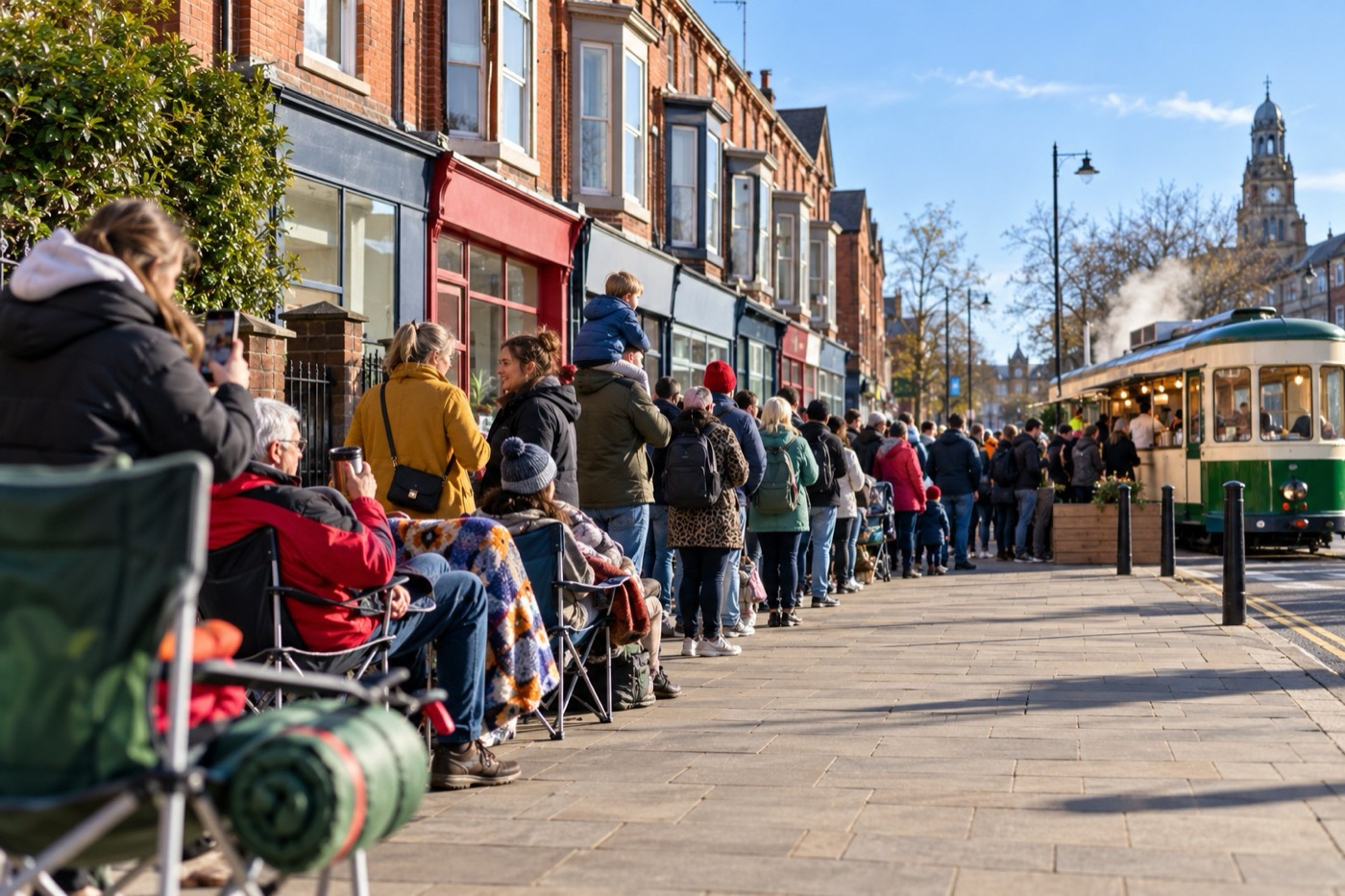
Jacob and Harley Nelson sell baked potatoes from a converted tram in Preston. Their videos brought the crowds, and the crowds became the attraction.
Before you read
1Warm up3 questions
Talk about these questions with a partner.
- What food would you queue an hour to try?
- Does a long queue make something look better to you?
- Would you travel for a snack you had seen in a video?
2Key words8 words
These words are in the article. Choose the letter of the meaning for each one.
- converted
- attraction
- influencer
- downside
- trend
- extraordinary
- fillings
- queue
- Aa place or thing that many people want to visit
- Ba bad part of something that is good in other ways
- Csomething that many people suddenly like or do
- Dthe food that goes inside or on top, like cheese or beans
- Echanged so that it can be used in a new way
- Fa line of people who are waiting
- Gvery special, not normal
- Ha person with many online followers who tells them what to try
1Warm up3 questions
Talk about these questions with a partner.
- What food would you queue an hour to try?
- Does a long queue make something look better to you?
- Would you travel for a snack you had seen in a video?
2Key words8 words
These words are in the article. Choose the letter of the meaning for each one.
- converted
- portions
- pavement
- viral
- following
- recommendation
- enthusiastic
- psychological
- Achanged so that it can be used in a new way
- Bvery excited and interested
- Cthe amounts of food that are given to one person
- Dspreading very quickly between people online
- Eadvice telling people that something is good
- Fconnected with how people think and feel
- Gthe path at the side of a road where people walk
- Hthe people who regularly watch what you post online
1Warm up3 questions
Talk about these questions with a partner.
- What food would you queue an hour to try?
- Does a long queue make something look better to you?
- Would you travel for a snack you had seen in a video?
2Key words8 words
These words are in the article. Choose the letter of the meaning for each one.
- phenomenon
- virality
- visibility
- entrepreneurial
- desirability
- hospitality
- sensation
- encounters
- Ashort meetings between people
- Bthe way something spreads very fast online
- Csomething that suddenly makes everyone excited
- Dhow easy it is for people to see or notice you
- Ethe business of hotels, restaurants and cafés
- Fhow much people want something
- Ggood at starting and running a business
- Hsomething unusual that happens and interests many people
Read
3Read the article
The paragraphs are numbered. Look out for the key words from task 2.
Core version
Imagine waiting outside a food stall all night. You're not waiting for a famous chef or a special meal. You're waiting for a baked potato. It sounds ridiculous, but the owners of a business in Preston, in northern England, say it happens. The brothers behind SpudBros say that some people have camped out nearby and waited almost 24 hours to buy one of their loaded jacket potatoes. We only have the brothers' word for the waiting time.
Jacob and Harley Nelson sell baked potatoes from a converted tram. Their food is simple: a jacket potato, which is a large potato baked in its skin, with fillings such as cheese, beans or chilli. However, the brothers did something that changed their business. They began putting out videos on social media. People enjoyed watching them prepare the food, talk to customers and add generous amounts of filling. Their videos reached millions of viewers.
The business soon became an internet attraction. Fans travelled to Preston from other towns and even other countries. Some wanted to taste the food, but they also wanted to take photos and tell their friends they had been there. A normal lunch had become an experience. The queue itself was part of the excitement, because a long line made the food look even more popular.
This is happening at other food businesses too. Small bakeries, ice-cream shops and cafés can suddenly become famous when an influencer shares a video. For the owners, that attention can be extremely helpful. It brings new customers at a time when rent, food and energy costs are high. A small business that used to struggle to attract people may suddenly have more customers than it can serve.
But internet fame has a downside. Staff can feel exhausted, local people may find it difficult to buy food from a shop they used to visit regularly, and customers who have travelled a long way may be disappointed. A video can make a meal seem extraordinary, even when it is only an ordinary, well-made snack. Popularity can also disappear quickly when viewers move on to the next trend.
There is nothing wrong with enjoying a baked potato, and the brothers have worked hard to make their business successful. Yet their story says something interesting about how we choose where to eat. We often trust what we see online, especially when thousands of other people seem excited. The next time you see a huge queue outside a café, it might be worth asking whether everyone is waiting for the food or for the chance to say they joined the queue.
Intermediate version
SpudBros is a business run by brothers Jacob and Harley Nelson from a converted tram in Preston, Lancashire. It sells baked potatoes piled high with fillings, which is hardly the kind of food you would normally travel across the country for. Yet the brothers say that people have queued overnight and waited almost 24 hours to buy one.
The brothers began posting videos when business was difficult during the pandemic. Their clips showed potatoes being prepared, customers reacting and enormous portions being served. The format was simple, entertaining and easy to share. As their following grew, so did the crowds. Visitors arrived from distant towns and overseas, hoping to taste the potatoes they had already watched countless times on their phones. The brothers now operate in the strange space between running a food business and being internet personalities.
SpudBros is part of a much wider trend. A recommendation from the right content creator can transform an ordinary café into the place everybody suddenly wants to visit. In London, popular bakeries, frozen yoghurt shops and takeaway businesses have found themselves dealing with queues that stretch along the pavement. For owners facing rising rents and food costs, this kind of attention can be a lifeline. Free publicity may achieve what an expensive advertising campaign could not.
But going viral creates problems of its own. Staff may struggle to keep up with demand, regular customers can feel pushed aside, and neighbourhoods have to deal with crowds that arrive almost overnight. Restaurants also risk disappointing visitors whose expectations have been raised by carefully filmed videos. A perfectly good meal may seem underwhelming after somebody has travelled three hours and then queued for hours.
There is a psychological element to all this. People are more likely to become interested in something when they can see that others want it. A long queue acts as a public recommendation, while posting a photograph proves that you were part of the moment. Some customers probably care just as much about the story they can tell afterwards as the meal they have bought. Restaurants are not simply selling food; increasingly, they are selling an experience that can be shared online.
The Nelson brothers have shown how much a small business can achieve by understanding that world. But their success also reveals its limits. Online attention is unpredictable, and even the most enthusiastic followers eventually drift away. For customers, the more interesting question is whether the potato would still be worth buying without the camera, the famous visitors or the queue. Perhaps the test of a good lunch is whether you would return for more when nobody is filming.
Advanced version
A baked potato from a converted tram in Preston has become a destination. The brothers behind SpudBros say some customers have slept outside and waited almost 24 hours for their loaded jacket potatoes. Videos helped draw visitors from far beyond Lancashire. Now lunch comes with a second attraction: being part of the queue everyone has seen online.
Jacob and Harley Nelson built up their following by filming the everyday business of preparing and selling potatoes. Their videos captured generous toppings, lively encounters with customers and the brothers' own on-camera personalities. The approach came about during a difficult period for the business and eventually attracted audiences far beyond Preston. Visitors began arriving from other parts of Britain and overseas, drawn not merely by the promise of lunch but by the opportunity to participate in a story they already knew from their screens.
The phenomenon extends well beyond potatoes. Restaurants and bakeries across Britain have discovered that a single enthusiastic online recommendation can generate queues that traditional advertising would struggle to produce. During a period of rising costs and precarious margins, sudden visibility can rescue a struggling business. It can also transform a small operator's relationship with customers, employees and the surrounding neighbourhood. Virality delivers attention at remarkable speed, without necessarily providing the time or resources required to accommodate it.
That is where the bargain becomes less appealing. Staff face exhausting peaks of demand, loyal customers lose easy access to businesses they helped sustain, and residents must put up with unexpected crowds. Nor does the customer always benefit. A meal that might have been entirely satisfying after a short wait can become a disappointment once inflated expectations, travel expenses and hours of queueing are taken into account. The camera is very good at capturing melted cheese; it is less interested in the practical inconvenience of obtaining it.
Queues also change what people think they are buying. Research into consumer behaviour suggests that visible approval from others can influence food choices, while social platforms reward places that photograph well and generate strong reactions. Waiting becomes a signal of desirability, and posting about the wait turns an ordinary purchase into a small performance of cultural participation. The experience is self-reinforcing: a crowd attracts attention, the attention attracts more people, and the expanding queue provides fresh evidence that the attraction must be worthwhile.
None of this means the food is poor or that customers are foolish. SpudBros has shown entrepreneurial skill, and there is something pleasing about a simple potato enjoying its moment in the spotlight. The concern is a hospitality culture in which survival increasingly depends on being noticed, preferably all at once. Small businesses need loyal customers and sustainable margins, not merely a brief spell of internet celebrity. Once the cameras turn towards the next sensation, a restaurant must still persuade people to return for the less glamorous reason that its food is worth eating.
After you read
4True, false or not given5 statements
Choose T (true), F (false) or NG (the article does not say).
- SpudBros sell baked potatoes from a converted tram.
The text says: "Jacob and Harley Nelson sell baked potatoes from a converted tram."
- The brothers became famous through newspaper advertising.
The text says the opposite: "They began putting out videos on social media."
- The brothers plan to open a second location.
Not stated. The text does not say whether the brothers plan a second location.
- Fans have travelled from other countries to visit.
The text says: "Fans travelled to Preston from other towns and even other countries."
- The text says rising costs can make new customers very useful for a small business.
The text says attention "brings new customers at a time when rent, food and energy costs are high".
5Vocabulary5 gaps
Complete the sentences with words from the box. Two words are not needed.
attentioncustomerdisappointedgenerousordinarypopularitystruggle
- The cook was with the cheese and put a big handful on every potato.
- Fans who travel a long way can feel if the food is not as good as the video.
- Many small shops to pay their rent when prices go up.
- Nobody was paying to the menu; they only wanted to film the potato.
- The of the shop grew quickly, and soon people waited in the street all day.
6Verb forms5 gaps
Write the correct form of the verb in brackets.
- The brothers videos online when business was slow. (MAKE)
- People enjoyed them prepare the food. (WATCH)
- Their videos millions of viewers. (REACH)
- Many visitors a potato, then ate it in the street. (BUY)
- The queue longer every hour. (GROW)
7Language focuscollocations
Complete the sentences with words from the box. Two words are not needed. A collocation is a pair of words that sound right together. Think about the other word in the sentence and choose the partner.
givehardjoinmakepaytaketell
- Many visitors photos of the food before they eat it.
- Small cafés must rent every month, even when business is slow.
- Visitors have to the queue and wait for hours.
- The brothers have worked to make their business a success.
- Fans like to their friends that they were there.
4True, false or not given5 statements
Choose T (true), F (false) or NG (the article does not say).
- Online attention is reliable and lasts for years.
The text says the opposite: "Online attention is unpredictable, and even the most enthusiastic followers eventually drift away."
- The brothers started posting videos during the pandemic.
The text says: "The brothers began posting videos when business was difficult during the pandemic."
- Preston council has complained about the crowds.
Not stated. The text does not say whether Preston council has complained.
- The text suggests that some customers care about the story they can tell as much as the meal.
The text says: "Some customers probably care just as much about the story they can tell afterwards as the meal they have bought."
- The brothers began filming because business was going well.
The text says they began posting videos "when business was difficult during the pandemic".
5Vocabulary6 gaps
Complete the sentences with words from the box. Two words are not needed.
campaigncountlessDemandexpectationsformatoverseaspublicityunderwhelming
- The film got such good that the studio did not need to pay for adverts.
- The restaurant had been praised so much online that it could not live up to the high of its guests.
- The concert had looked amazing in the advert, but the real thing was rather .
- She has listened to that song times and still loves it.
- Many students who study return home with a second language.
- for the new phone was so high that shops sold out in an hour.
6Verb forms5 gaps
Write the correct form of the verb in brackets.
- By the time the queue reached the corner, many people for hours. (WAIT)
- Visitors from distant towns and overseas. (ARRIVE)
- Baked potatoes from a converted tram. (SERVE)
- If the video had not gone viral, the stall quiet. (STAY)
- The stall famous across the country since the videos spread. (BECOME)
7Language focuscollocations
Complete the sentences with words from the box. Two words are not needed. These pairs are fixed. Look at the noun that follows the gap and choose the verb that normally goes with it.
boostdrawgainholdlosepayspend
- A well-known chef can crowds to a new restaurant.
- A single video can sales overnight.
- Fans soon interest when a new trend appears.
- Many visitors a high price for a dish that is not special.
- A café can thousands of followers in a week.
4True, false or not given5 statements
Choose T (true), F (false) or NG (the article does not say).
- The writer suggests that a crowd can make a restaurant look better than the food alone would.
Waiting becomes "a signal of desirability" and the queue "provides fresh evidence that the attraction must be worthwhile".
- The text implies that a customer who waits only briefly is likely to be disappointed.
A meal "might have been entirely satisfying after a short wait"; disappointment comes with long waits and high expectations.
- SpudBros now employs more than twenty people.
Not stated. The text does not say how many people SpudBros employs.
- The text presents the potato queue as one example of a pattern found at other British businesses.
"The phenomenon extends well beyond potatoes. Restaurants and bakeries across Britain have discovered" similar queues.
- The writer believes sudden fame matters more to a small business than loyal customers.
"Small businesses need loyal customers and sustainable margins, not merely a brief spell of internet celebrity."
5Vocabulary6 gaps
Complete the sentences with words from the box. Two words are not needed.
accommodatebargaininflatedmarginsmerelypeaksspotlightsustain
- The restaurant had to move premises because the original dining room simply could not the weekend crowds.
- Customers who had travelled for hours left with hopes that no ordinary lunch could satisfy.
- Independent cafés often operate on such narrow that a single bad month can threaten their future.
- Occasional bursts of fame cannot a business; only repeat custom can.
- The owner insisted that the viral clip was a lucky break, not a plan for the future.
- Fame in return for being overrun by crowds is a poor for a quiet family business.
6Word forms5 gaps
Use the word in brackets to make a word that fits the gap.
- The restaurant's depends almost entirely on word of mouth. (SURVIVE)
- Reviewers found the food perfectly pleasant but . (REMARK)
- The of online attention makes long-term planning almost impossible. (PREDICT)
- Her to queue for hours in freezing weather was widely admired. (WILLING)
- Many small firms suffer from a to sudden shifts in online fashion. (VULNERABLE)
7Language focuscollocations
Complete the sentences with words from the box. Two words are not needed. At C1, a precise verb or adjective is chosen for the noun beside it. Test each word in the box against the noun it must sit with.
fleetingfuelmeteoricmountingreaptentativewield
- Owners who go viral may the rewards quickly, but struggle to keep them.
- The café enjoyed a rise, going from empty to fully booked in a fortnight.
- Internet fame is notoriously : today's sensation is tomorrow's forgotten trend.
- Rising rents have put pressure on independent restaurants.
- Pictures of overflowing plates help to demand for the product even further.
Speak
8Talk about it3 questions
Discuss in pairs or small groups. Give reasons for your answers.
- When does the queue become part of the experience?
- Would you trust local advice or a viral food review more?
- What would persuade you that a famous food was worth the wait?
8Talk about it3 questions
Discuss in pairs or small groups. Give reasons for your answers.
- When does the queue become part of the experience?
- Would you trust local advice or a viral food review more?
- What would persuade you that a famous food was worth the wait?
8Talk about it3 questions
Discuss in pairs or small groups. Give reasons for your answers.
- When does the queue become part of the experience?
- Would you trust local advice or a viral food review more?
- What would persuade you that a famous food was worth the wait?
9Role-play: the famous queue
Work in pairs. Read your card, then have the conversation. Swap roles and do it again.
Student A · the friend who wants to go
You've seen a famous food stall online. The queue is very long and some people wait all night. Ask your friend to come with you. Explain why you want to go and how you'll make the wait easier.
Student B · the friend who isn't sure
Your friend wants to wait a very long time for a famous snack. You think it's too much. Ask at least two questions, then say yes, say no, or suggest a different plan.
Useful phrases
- I'd love to try it, it's all over my feed.
- Isn't it a bit silly to wait that long for a potato?
- We could go on a weekday, when it's quieter.
- I don't mind queuing if we take chairs and snacks.
- That's a lot of time for one meal.
- Let's compromise: we'll wait two hours, not twenty-four.
Afterwards, tell the class: did your friend agree to go, and was the plan fair?
Your words
Highlights0 saved
Highlights0 saved
Highlights0 saved
Was this lesson useful? Support johnplusnews on Ko-fi
Continue reading
Food
The Chef Who Lost His Job Over Pineapple
An Italian chef in Australia was sacked for refusing to add pineapple. A food historian says the rule he was defending is younger than he thinks.
History
Were People Getting High 2,800 Years Ago?
Cannabis seeds and chemical traces in preserved hair from a Siberian tomb suggest that some Scythians were exposed to its intoxicating compounds about 2,800 years ago. The evidence is strong, but it leaves many questions open.
Lifestyle
Can You Learn a Better Life from an Italian Grandmother?
Two friends in their late eighties bake bread in a small Italian town. The internet has decided they are the answer to something.