News lesson13 October 2026
The Ancient Statues Found Near Someone's Home
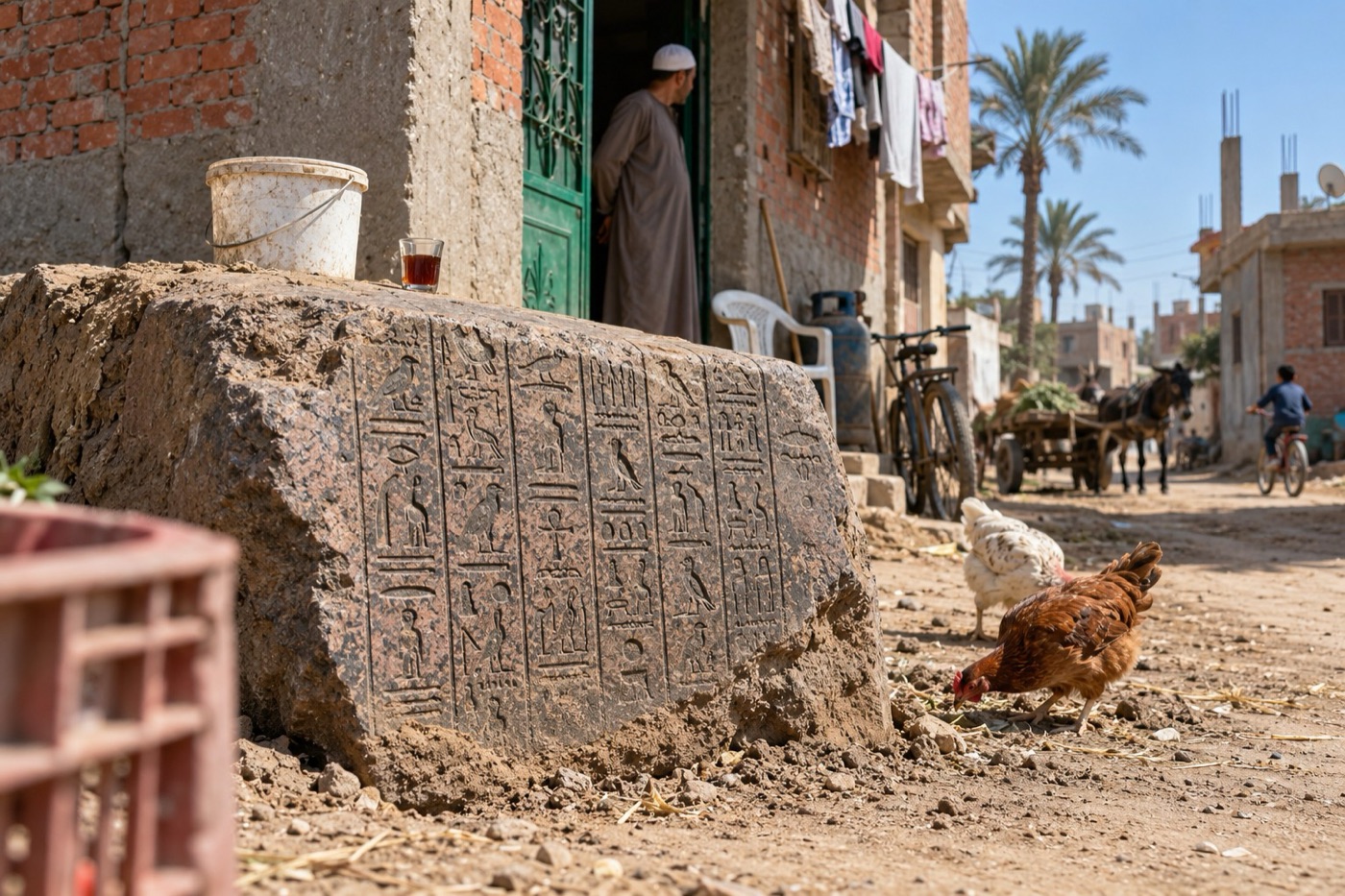
A resident of Bahbit al-Higara could have moved the inscribed stone or sold it. Instead he called the authorities, and a careful excavation began.
Before you read
1Warm up3 questions
Talk about these questions with a partner.
- What is the most interesting old object you have seen?
- If you found a strange object in your garden, what would you do first?
- Would you rather uncover an ancient building or a tiny personal object?
2Key words8 words
These words are in the article. Choose the letter of the meaning for each one.
- resident
- archaeologists
- granite
- goddess
- monuments
- authorities
- site
- religion
- Apeople who study the past by looking at old things in the ground
- Bbig buildings or statues made to remember a person or event
- Ca female god
- Da very hard grey or pink stone
- Ea belief in a god or gods
- Fa person who lives in a place
- Ga place where something happens or is found
- Hthe people or offices that are in charge
1Warm up3 questions
Talk about these questions with a partner.
- What is the most interesting old object you have seen?
- If you found a strange object in your garden, what would you do first?
- Would you rather uncover an ancient building or a tiny personal object?
2Key words8 words
These words are in the article. Choose the letter of the meaning for each one.
- inscribed
- excavation
- hieroglyphs
- artefact
- sacred
- reign
- systematically
- specialists
- Aan old object made by people
- Bin a careful, organised way, step by step
- Cpeople who know a lot about one subject
- Dthe pictures and symbols used in ancient Egyptian writing
- Ewith words or marks cut into the surface
- Fthe time when a king or queen rules
- Gthe work of digging carefully to find things from the past
- Hvery important in a religion
1Warm up3 questions
Talk about these questions with a partner.
- What is the most interesting old object you have seen?
- If you found a strange object in your garden, what would you do first?
- Would you rather uncover an ancient building or a tiny personal object?
2Key words8 words
These words are in the article. Choose the letter of the meaning for each one.
- hieroglyphs
- granite
- carving
- layers
- excavation
- antiquities
- investigated
- resident
- Alevels of material lying one on top of another
- Bthe pictures and symbols used in ancient Egyptian writing
- Ca person who lives in a particular place
- Dexamined carefully to find out the facts
- Ea very hard stone, often grey or pink
- Fa shape or picture cut into stone or wood
- Gobjects and buildings from the ancient past
- Hthe careful digging of a site to find old objects
Read
3Read the article
The paragraphs are numbered. Look out for the key words from task 2.
Core version
In October 2026, a resident of Bahbit al-Higara, a village in the Nile Delta of northern Egypt, noticed a strange stone near his home. It had writing on it. He could have thrown it away or kept it. Instead, he reported it to the experts, and his decision led archaeologists to something remarkable.
Experts from Egypt's antiquities authorities came to take a closer look. When they began digging, they found parts of two enormous statues and a block of pink granite covered in ancient writing.
The statues were connected to Ramesses II, a famous king of ancient Egypt. He ruled more than 3,000 years ago and is remembered for building impressive temples and monuments. One statue head was about 1.6 metres tall. Experts believe the complete statue may once have stood around 8.5 metres high, which is taller than a two-storey house.
The objects were found near the remains of a temple linked to Isis, an important goddess in ancient Egyptian religion. That makes the location especially interesting to archaeologists. A giant statue of a king standing close to a temple can show how religion and royal power were connected. The new finds may also help experts work out how people used the area thousands of years ago.
Discoveries like this are not simply about beautiful old objects. A broken statue can tell historians about religion, power and the way people organised their cities. Even the exact position of an object in the ground can provide valuable information. If somebody digs a statue up and carries it away, that information is lost for good.
The man who reported the stone could not have known what was waiting beneath the surface. By getting in touch with the authorities, he helped protect the site for future study. Archaeologists still have plenty of work to do before they can explain where the statues once stood. Sometimes a small discovery opens the door to a much bigger piece of history.
Intermediate version
An ordinary piece of land in northern Egypt turned into an archaeological site after a resident noticed an unusual inscribed stone. Instead of trying to move it or sell it on, he contacted the authorities. The resulting excavation brought to light fragments of two huge royal statues associated with Ramesses II, along with a granite block bearing hieroglyphs.
The discovery was announced in October 2026 in Bahbit al-Higara, a village in the Nile Delta. The site lies close to the remains of a temple connected with Isis, an important goddess in ancient Egyptian religion. Specialists from Egypt's Supreme Council of Antiquities inspected the original stone and then carried out a rescue excavation. This is urgent work to record and protect a find before anything is lifted out of the ground.
One of the most striking finds was a statue head measuring roughly 1.6 metres high. Archaeologists estimate that the complete figure may originally have been approximately 8.5 metres tall. A head alone of that size gives some idea of the effort that went into cutting, moving and raising the finished statue. Monuments on that scale were not merely decorative. Such figures were presumably meant to be seen from a distance, and they helped communicate the authority of kings and the close relationship between royal power and religion.
Ramesses II ruled during the thirteenth century BC and is famous for the monumental buildings associated with his long reign. The newly discovered pieces are especially valuable because they turned up in an archaeological context. Their position, the material around them and the inscriptions may shed light on how this part of the Nile Delta developed, and on how a sacred landscape was laid out.
Archaeology involves far more than digging up treasure. Removing an artefact without documenting where it lay tends to destroy evidence about its history, and that evidence cannot be recovered afterwards. An object that has been pulled out of the ground by chance may still be beautiful, but it is likely to tell researchers very little.
That is why the resident's decision to report the stone was so significant. The authorities were able to investigate the site systematically instead of being handed an isolated object with no clear background. The alternative is that finds slip quietly into private hands, taking their history with them.
There is still work to do before researchers can explain precisely where the statues stood and what purpose they served. They will want to compare the fragments with other monuments from the same reign before they draw any firm conclusions. Nevertheless, the find offers a reminder that the ancient world has not disappeared. Sometimes it is still hidden beneath the places where people live and work today.
Advanced version
An unusual stone near a home in Egypt led officials to something much larger. In October 2026, a resident of Bahbit al-Higara, in the Nile Delta, reported writing he had noticed on a stone while working on nearby land. Antiquities officials investigated. Beneath the everyday surroundings were fragments of two enormous royal statues linked to Ramesses II.
Specialists from Egypt's Supreme Council of Antiquities also uncovered a block of pink granite covered in hieroglyphs, the ancient Egyptian writing system. One statue head was about 1.6 metres tall. Officials believe it came from a figure that originally stood around 8.5 metres high. Even broken into pieces, it gives a sense of the scale the builders were working on.
Ramesses II ruled in the thirteenth century BC and commissioned monuments on a grand scale. A towering statue did more than show people what their king looked like: it made his power visible. The newly discovered pieces were found near a major ancient sanctuary associated with the goddess Isis. Researchers still need to work out how the statues fitted into the surrounding site.
That is where the ground around an object becomes part of its story. Archaeologists record the layers of earth, nearby buildings and other finds before moving a piece. Those details can help them understand where it stood and what happened to it. A head in a museum may be impressive, but its original position could answer questions the carving alone cannot.
For the same reason, finding something old is not simply a matter of lifting it out and taking it away. Moving a fragment before its position is recorded can destroy information that cannot be put back. The resident's decision to report the stone gave specialists the chance to investigate it in place. The discovery began with somebody noticing something; understanding it depends on what happens next.
There is plenty still to establish. The fragments do not yet give a complete picture of the statues or their original arrangement. Further excavation and comparisons with other finds may change the explanation. For now, the stone has opened a window onto a much larger site. The most striking object may be the giant head, but some of the best clues are still around it.
After you read
4True, false or not given5 statements
Choose T (true), F (false) or NG (the article does not say).
- One of the statue heads was more than one and a half metres tall.
The text says: "One statue head was about 1.6 metres tall."
- The complete statue may once have been taller than a two-storey house.
The text says it may have stood around 8.5 metres high, "which is taller than a two-storey house".
- Archaeologists found the statues close to a temple linked to a goddess.
The text says: "The objects were found near the remains of a temple linked to Isis, an important goddess in ancient Egyptian religion."
- The statues will be moved to a museum in Cairo.
Not stated. The text does not say where the statues will be kept after the excavation.
- The resident kept the stone and sold it privately.
The text says the opposite: "Instead, he reported it to the experts, and his decision led archaeologists to something remarkable."
5Vocabulary5 gaps
Complete the sentences with words from the box. Two words are not needed.
ancientenormousexplainorganiseprotectremainsvaluable
- The statue was so that it would not fit through the door of an ordinary house.
- Old coins can be very to a museum, even when they are small.
- Guards were sent to the site so that nobody could steal anything.
- The guide was asked to why the statue was so big.
- Only the of the old wall were left, and most of it had fallen down.
6Verb forms5 gaps
Write the correct form of the verb in brackets.
- He could have the stone away or kept it. (THROW)
- His decision archaeologists to something remarkable. (LEAD)
- Ramesses II more than 3,000 years ago. (RULE)
- He for building impressive temples and monuments. (REMEMBER)
- Archaeologists still have plenty of work . (DO)
7Language focusphrasal verbs
Complete the sentences with words from the box. Two words are not needed. A phrasal verb is a verb plus a small word, like out or away. The small word changes the meaning, so learn them together.
awaygivelookonoutroundwork
- The experts will out how old the statue is.
- Please do not carry the stones ; leave them where you found them.
- It looked like an ordinary stone, but it turned to be a piece of history.
- The team will carry with the dig next week.
- The guide asked us to after the stone, because it is very old.
4True, false or not given5 statements
Choose T (true), F (false) or NG (the article does not say).
- Experts think the whole statue may have been over eight metres high.
The text says: "Archaeologists estimate that the complete figure may originally have been approximately 8.5 metres tall."
- The resident received a payment from the antiquities authority.
Not stated. The text does not say whether the resident was paid.
- Specialists inspected the stone before they started a rescue excavation.
The text says: "Specialists from Egypt's Supreme Council of Antiquities inspected the original stone and then carried out a rescue excavation."
- Researchers already know exactly where the statues stood.
The text says the opposite: "There is still work to do before researchers can explain precisely where the statues stood and what purpose they served."
- The writer thinks an object found by chance is likely to teach researchers less than one found during a proper excavation.
The text says such an object "may still be beautiful, but it is likely to tell researchers very little".
5Vocabulary6 gaps
Complete the sentences with words from the box. Two words are not needed.
approximatelyestimateevidencefragmentsinspectedisolatedpresumablyurgent
- The vase was broken into dozens of small , which the museum staff carefully glued together.
- The roof was leaking badly, so the repair was and could not wait until spring.
- The police found no that anyone had broken into the house.
- Doctors were not worried because it was a single, incident and not part of a pattern.
- Engineers that the repairs will cost around two million pounds.
- He was the best candidate, since he had the most experience, but the interviews were not finished.
6Verb forms5 gaps
Write the correct form of the verb in brackets.
- By the time the experts arrived, the resident the authorities. (CONTACT)
- The ruins by law since they were declared a national monument. (PROTECT)
- If the man had sold the stone, researchers the statues. (NEVER FIND)
- When the rain began, the specialists still the layers of earth. (RECORD)
- Last year, an old coin in a garden in our town. (DISCOVER)
7Language focusphrasal verbs
Complete the sentences with words from the box. Two words are not needed. Many phrasal verbs have a meaning you cannot guess from the parts. Learn the whole verb, for example look into means to investigate.
breakcarryendforwardholdlookout
- The team will out a rescue excavation before the builders arrive.
- Experts will into the history of the statue before they publish anything.
- Without a record, a find can up in a private collection.
- The authorities asked the public to come if they had information.
- The archaeologist pointed that the statue was once much taller.
4True, false or not given5 statements
Choose T (true), F (false) or NG (the article does not say).
- The writer implies that a head displayed in a museum may have lost part of its historical value.
The text says a head in a museum may be impressive, but its original position "could answer questions the carving alone cannot".
- The complete figure was more than five times taller than the head that was found.
The head was about 1.6 metres tall and the figure about 8.5 metres, and 8.5 divided by 1.6 is just over five.
- The original arrangement of the statues is already well understood.
The text says the fragments "do not yet give a complete picture of the statues or their original arrangement".
- The resident was paid a reward by the Supreme Council of Antiquities.
The text does not say whether the resident received any payment.
- Experts have ruled out changing their explanation of the site.
The text says further excavation and comparisons "may change the explanation".
5Vocabulary6 gaps
Complete the sentences with words from the box. Two words are not needed.
associatedcluescomparisonsestablishfragmentslayersscaleuncovered
- The festival is closely with the harvest, though its exact origins remain unclear.
- An internal audit a pattern of irregular payments that nobody had noticed.
- It took the inquiry months to who had authorised the transfer.
- Only of the original manuscript survive, so scholars must reconstruct much of the argument.
- Careful between the two sets of figures revealed a small but consistent gap.
- On that , even a minor error would have serious consequences.
6Word forms5 gaps
Use the word in brackets to make a word that fits the gap.
- Scholars have questioned the of the traditional dating of the monument. (RELY)
- The of the fragments in the soil suggests they were moved long ago. (DISPLACE)
- Several experts expressed about the proposed interpretation. (SCEPTIC)
- It would be to draw firm conclusions from so few pieces. (ADVISE)
- Thorough of every layer is essential if the site is to be understood later. (DOCUMENT)
7Language focusphrasal verbs
Complete the sentences with words from the box. Two words are not needed. At this level, many phrasal verbs are fairly formal. Check whether the meaning is literal or figurative: brush aside means to dismiss something.
bringbrushburydigplayrulestem
- Investigators refused to aside the possibility that the damage was deliberate.
- Many of the site's problems from decades of neglect.
- Officials were accused of trying to down the seriousness of the damage.
- The findings should not out further excavation at the site.
- Careful recording can about a far better understanding of the site.
Speak
8Talk about it3 questions
Discuss in pairs or small groups. Give reasons for your answers.
- Who should decide what happens to something old found on private land?
- Which everyday object from today might interest people in 3,000 years?
- Would you enjoy living near a place where history keeps turning up?
9Role-play: what should we do with the stone?
Work in pairs. Read your card, then have the conversation. Swap roles and do it again.
Student A · the neighbour
Your neighbour has found a strange stone with writing on it. You think it could be worth a lot of money. Try to persuade your neighbour to keep it or sell it. Ask at least two questions.
Student B · the finder
You found a strange stone with writing on it near your home. You want to report it to the experts. Explain why, and answer your neighbour's ideas politely.
Useful phrases
- I think it could be worth a lot of money.
- What if it's really important?
- I'd rather call the experts first.
- That's not a good idea, because we don't know what it is.
- Let's find out what it is before we decide.
- We could both agree to ask for advice.
Afterwards, tell the class: what did you decide to do with the stone, and why?
Your words
Highlights0 saved
Highlights0 saved
Highlights0 saved
Was this lesson useful? Support johnplusnews on Ko-fi
Continue reading
Food
The Chef Who Lost His Job Over Pineapple
An Italian chef in Australia was sacked for refusing to add pineapple. A food historian says the rule he was defending is younger than he thinks.
History
Were People Getting High 2,800 Years Ago?
Cannabis seeds and chemical traces in preserved hair from a Siberian tomb suggest that some Scythians were exposed to its intoxicating compounds about 2,800 years ago. The evidence is strong, but it leaves many questions open.
Culture
Why Young People Are Turning Up to Ceilidhs
An old Scottish and Irish dance is filling pubs with people in their twenties. Ticket sales are up, and nobody has to arrive with friends.