News lessonOctober 2026
Has Streaming Beaten the Cinema?
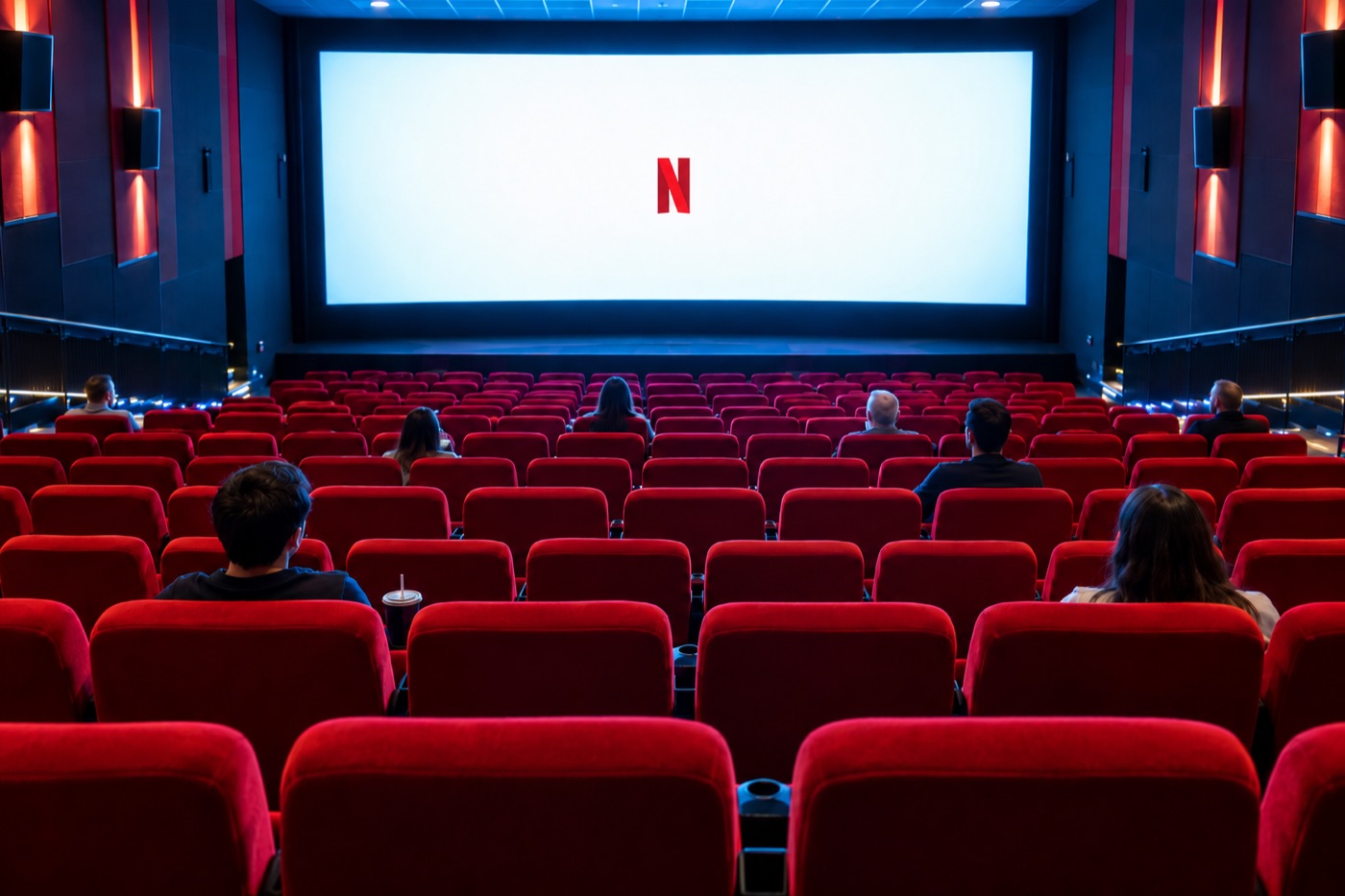
Streaming has changed an ordinary film night. Cinemas now need to offer an experience worth leaving home for.
Before you read
1Warm up3 questions
Talk about these questions with a partner.
- Where do you prefer to watch a new film?
- What is the best thing about watching at home?
- What makes a cinema visit special?
2Key words8 words
These words are in the article. Choose the letter of the meaning for each one.
- poll
- scale
- journey
- comfortable
- disappeared
- habit
- research
- recently
- Acareful study to find out new facts
- Bhow big something is
- Ca trip from one place to another
- Dsomething you do often, without thinking
- Ea set of questions asked to many people to find out what they think
- Fnice and easy on your body, so you feel relaxed
- Gwent away and could not be seen any more
- Hnot long ago
1Warm up3 questions
Talk about these questions with a partner.
- Which matters more on film night: comfort, price or atmosphere?
- What kind of film deserves a big screen?
- Do phones make it harder to enjoy a film at home?
2Key words8 words
These words are in the article. Choose the letter of the meaning for each one.
- striking
- subscription
- conducted
- loyalty
- admissions
- collapse
- timetable
- rewards
- Aa sudden failure or fall
- Bthe number of people who enter a place
- Corganised and done, for example a poll
- Dgives something good in return for time or effort
- Emoney you pay regularly to use a service
- Fa list of the times when things happen
- Gso unusual or surprising that you notice it
- Hstaying faithful to one thing and not changing
1Warm up3 questions
Talk about these questions with a partner.
- Has cinema become an event rather than a habit?
- Are people paying for a film at the cinema, or for two hours of focused attention?
- What would cinemas need to offer that a living room cannot?
2Key words8 words
These words are in the article. Choose the letter of the meaning for each one.
- fielded
- sociable
- justifies
- decline
- abandon
- outing
- range
- route
- Acarried out, used about a survey
- Ba short trip for pleasure
- Cthe variety of things of one kind
- Dthe way you take to get somewhere
- Egives a good reason for something
- Fto leave something for good
- Genjoying being with other people
- Ha gradual fall in size or quality
Read
3Read the article
The paragraphs are numbered. Look out for the key words from task 2.
Core version
It is Friday evening and there is a new film you want to see. You can put on a coat, travel across town and buy a ticket. Or you can stay where you are, make something to eat and stream it on the screen in the corner of the room. Millions of people make that choice every week, and more and more of them stay at home.
An American poll gives a sense of the scale. AP-NORC asked 1,182 adults in August 2025 about their film habits. Three quarters of them had watched a recently released film at home instead of going to the cinema at least once during the previous year. Only 16% said they go to a cinema at least once a month.
The reasons are not hard to guess. At home you can pause the film, eat your own food and watch in comfortable clothes. One monthly payment covers the whole household, while cinema tickets are bought one at a time. For a family, the difference in price is large.
The cinema has not disappeared, though. In Europe, about 796 million cinema tickets were sold in 2025. That is fewer than the year before, but it is still an enormous number of people choosing to leave the house for a film.
It is also not a straight choice between the two. Plenty of people stream most weeks and still book tickets a few times a year. The habit has changed, not the taste.
What do they get for the journey? A screen far bigger than any television. Sound you can feel. And a room full of strangers reacting at the same moment, which is something a sofa cannot provide. Research by the British Film Institute in 2025 found that younger adults valued the cinema partly because it is a place where they actually watch, without checking a phone.
That may be the real change. The cinema used to be the normal way to see a new film. Now it is a decision, and people save it for the films they think deserve it. The question is no longer whether you watch at home. It is which film is worth the trip.
Intermediate version
Friday night presents the same small decision in most households. There is a film worth seeing, and there are two ways to see it: buy tickets and travel, or wait a few weeks until it arrives on a service you already pay for. Convenience usually wins.
The evidence from the United States is striking. In a poll of 1,182 adults conducted in August 2025, AP-NORC found that three quarters had streamed a recently released film at home rather than watching it in a cinema at least once in the previous year. Around a third streamed a new release at home every month, while only 16% visited a cinema that often.
Those figures describe American viewers, and they describe frequency rather than loyalty. The same poll suggests many people do both. What has changed is which option feels automatic, and the automatic option is now the one that requires no coat, no timetable and no second ticket.
Money matters too. A single subscription covers a household for a month, and nobody has to agree on a start time. Cinema prices are paid per person, per visit, and the cost rises with the size of the group. For a family of four, an ordinary evening out can cost more than a month of watching at home.
Who goes also depends on what they earn. In the same American poll, 72% of adults earning $100,000 or more had been to a cinema, against 54% of those earning under $50,000. When a night out costs four tickets, the sofa is not only more convenient; for some households it is the only realistic option.
Cinemas have responded by selling the atmosphere a living room cannot reproduce. The British Film Institute's audience research, carried out in March 2025, found that young adults in the UK valued the cinema as a focused and social occasion. Only 14% wanted cinemas to relax their rules about talking or phone use, which suggests that the attention is part of the attraction rather than an inconvenience.
The industry figures show survival rather than collapse. European admissions fell by around 5.5% in 2025 to roughly 796 million, yet box office revenue stayed broadly level. Worldwide, takings rose about 5% that year while remaining some 30% below the average before the pandemic. Different markets are moving in different directions, and no single number captures all of them.
So the honest answer is that streaming has won the ordinary evening and the cinema has kept the occasion. An audience that chooses to be there, for a film that rewards the journey, is a smaller business than the one cinemas used to run. It is not obviously a dying one.
Advanced version
The interesting thing about the decline of cinema is how reliably it is announced and how stubbornly it fails to finish. Audiences did not abandon the building; they stopped treating it as the default. A film at home now requires no decision at all, which is precisely the problem for everybody who sells tickets.
The numbers describe a shift in habit rather than a verdict. AP-NORC surveyed 1,182 American adults in August 2025 and found three quarters had watched a recently released film at home instead of going out for it at least once in the preceding year. Roughly a third streamed a new release monthly, against 16% who went to a cinema that often. The poll is American and measures frequency, so it cannot be stretched into a global judgement, but the direction is not in doubt.
Price explains a good deal of it. A subscription is a fixed household cost that does not grow with the number of people watching, while a cinema charges per seat and per visit. Once the same film is available both ways, the building has to compete on something other than access, and access was the thing it used to own outright.
What remains is distinctive rather than convenient. Scale, sound and the absence of a pause button amount to an argument for attention, and audiences appear to understand it as such. The British Film Institute's audience tracker, fielded in March 2025, found that young adults in the UK prized the cinema as a focused and sociable outing, with only 14% wanting venues to be more relaxed about talking or phones. They are not asking for the living room with a larger screen.
The trade figures suggest an industry finding a smaller equilibrium rather than falling off a cliff. European attendance dropped about 5.5% in 2025, to somewhere near 796 million admissions, while box office revenue held almost steady. Global takings grew roughly 5% in the same year and still sat about 30% below their pre-pandemic average. Recovery has been uneven, and in several Asian markets it has been driven by national films rather than Hollywood releases.
The growth is also not where a Hollywood-shaped account would predict. The Observatory credits Asia's largest markets with most of the 2025 increase, and national films led the box office in several of them. A global figure assembled from very different national recoveries should be handled carefully.
A cinema that survives on occasions rather than habits is a different business, and the change carries a risk worth naming. If only spectacle justifies the journey, the quieter films that once filled a Tuesday screening may lose their route to an audience. That would be a loss of range, not merely of revenue.
Still, the shift is not simply a defeat. Something is being sold that streaming genuinely cannot supply: two hours in which the film is the only thing happening, in a room of people who all agreed to turn up. Scarcity has a way of making that feel more valuable, not less.
After you read
4True, false or not given5 statements
Choose T (true), F (false) or NG (the article does not say).
- AP-NORC asked 1,182 adults about their film habits in August 2025.
The text says: "AP-NORC asked 1,182 adults in August 2025 about their film habits."
- European cinemas sold more tickets in 2025 than in the year before.
The text says the opposite: "That is fewer than the year before, but it is still an enormous number of people choosing to leave the house for a film."
- Cinema tickets cost more now than they did ten years ago.
Not stated. The text says cinema tickets are bought one at a time, but it gives no prices from the past.
- The British Film Institute found that younger adults valued the cinema as a place where they actually watch.
The text says: "Research by the British Film Institute in 2025 found that younger adults valued the cinema partly because it is a place where they actually watch, without checking a phone."
- Plenty of people stream most weeks and never go to the cinema.
The text says plenty of people "stream most weeks and still book tickets a few times a year".
5Vocabulary5 gaps
Complete the sentences with words from the box. Two words are not needed.
audiencedeservedifferenceenormouspaymentqueuestrangers
- I made one monthly and now the whole family can watch.
- There is a big in price between a cinema ticket and a film at home.
- At a busy cinema you sit next to you have never met.
- The new stadium is , with space for eighty thousand people.
- Only the best films a trip to the cinema, many people say.
6Verb forms5 gaps
Write the correct form of the verb in brackets.
- It is Friday evening and there a new film you want to see. (BE)
- AP-NORC 1,182 adults in August 2025 about their film habits. (ASK)
- Three quarters of them a recently released film at home. (WATCH)
- About 796 million cinema tickets in Europe in 2025. (SELL)
- People the cinema for the films they think deserve it. (SAVE)
7Language focuslinking words
Complete the sentences with words from the box. Two words are not needed. Small words join ideas. Because gives a reason, but shows a contrast, so shows a result and while means at the same time.
becausebutdespitehoweversountilwhile
- We stayed at home the tickets were too expensive for all of us.
- The tickets were expensive, we went to the cinema anyway.
- There was no parking near the cinema, we took the bus.
- I like to eat popcorn I watch a film.
- Streaming is easy. , many people still prefer the cinema.
4True, false or not given5 statements
Choose T (true), F (false) or NG (the article does not say).
- A family of four may spend more on one cinema evening than on a month of streaming.
The text says an ordinary evening out "can cost more than a month of watching at home".
- Higher earners in the AP-NORC poll were less likely to have been to a cinema than lower earners.
72% of those earning $100,000 or more had been, against 54% of those earning under $50,000.
- Cinemas in Europe sold fewer tickets in 2025, but the money they took did not fall much.
Admissions fell by around 5.5%, "yet box office revenue stayed broadly level".
- Most young adults in the UK said they preferred the cinema to watching at home.
Not stated. The text says they valued the cinema as a focused and social occasion, but gives no preference figures.
- Worldwide takings in 2025 had returned to their pre-pandemic level.
They rose about 5% but "remained some 30% below the average before the pandemic".
5Vocabulary6 gaps
Complete the sentences with words from the box. Two words are not needed.
estimateevidencefrequencyoccasionreproducerevenuesurvivalvariety
- Researchers recorded the of visits, such as once a week or twice a year.
- A wedding is a special , so everyone dresses up.
- The company's yearly from ticket sales passed ten million pounds.
- The police had no that the man had been at the scene.
- No home speaker can fully the sound of a live orchestra.
- After the pandemic, the of small theatres was in doubt.
6Verb forms5 gaps
Write the correct form of the verb in brackets.
- By the time the poll ended, many adults a film at home. (STREAM)
- A single subscription a household for a month. (COVER)
- Cinema tickets separately for each person. (BUY)
- Streaming the ordinary evening, but the cinema has kept the occasion. (WIN)
- The survey out in March 2025. (CARRY)
7Language focuslinking words
Complete the sentences with words from the box. Two words are not needed. Some of these words need a noun after them and some need a full clause with a subject and verb. Check what follows the gap.
althoughdespiteneverthelessotherwiseprovidedthereforeunless
- the high prices, many families still go to the cinema.
- tickets have become more expensive, plenty of families still go out sometimes.
- A subscription is shared by the whole household. , the price per person is small.
- Cinemas will lose younger audiences they offer something a living room cannot.
- People must feel the film is worth the trip; , they will simply stay at home.
4True, false or not given5 statements
Choose T (true), F (false) or NG (the article does not say).
- The writer implies that cinemas can no longer rely on exclusive access to new films.
Access "was the thing it used to own outright", but the same film is now available both ways.
- The BFI found that most young adults wanted cinemas to be more relaxed about phones.
Only 14% wanted venues to be more relaxed about talking or phones.
- Global takings grew in 2025, yet were still lower than before the pandemic.
They "grew roughly 5%" but "still sat about 30% below their pre-pandemic average".
- Streaming services now release more quiet films than big spectacles.
Not stated. The text only worries that quieter films may lose their route to an audience at cinemas.
- The writer treats the AP-NORC results as proof that cinema is declining worldwide.
The poll "is American and measures frequency, so it cannot be stretched into a global judgement".
5Vocabulary6 gaps
Complete the sentences with words from the box. Two words are not needed.
assembleddismissedequilibriumoutrightprizedreinforcedstubbornlyverdict
- In the old market town, hand-made bread was above anything bought from a supermarket.
- After years of swings, the housing market has settled into a new at lower prices.
- The founder did not merely lead the firm; she owned it .
- The report was from interviews with hundreds of former employees.
- Despite every setback, the old picture house refused to close.
- The jury took only an hour to deliver its .
6Word forms5 gaps
Use the word in brackets to make a word that fits the gap.
- Trains on this line run on time. (RELY)
- The pitch was so that the match had to be postponed. (EVEN)
- Economic in the region have followed very different timetables. (RECOVER)
- A lapse of cost the manager his job. (JUDGE)
- The of skilled nurses is putting pressure on the hospital. (SCARCE)
7Language focuslinking words
Complete the sentences with words from the box. Two words are not needed. Some of these connectors join two clauses and others need a noun phrase. Watch the punctuation before the gap.
henceinasmuchnonethelessnotwithstandingprovidedtherebywhereas
- the rise of streaming, many people still queue for big releases.
- Ticket prices have risen; , attendance has held up.
- A subscription is a fixed household cost, a cinema charges per seat.
- Demand was higher than expected; the long queues outside.
- Cinemas can thrive they offer something a living room cannot.
Speak
8Talk about it3 questions
Discuss in pairs or small groups. Give reasons for your answers.
- You can stream a film tonight or see it at the cinema. Which do you choose, and why?
- How could cinemas make tickets feel worth the price?
- Is a film better when other people react with you?
8Talk about it3 questions
Discuss in pairs or small groups. Give reasons for your answers.
- What has streaming improved about watching films, and what has it weakened?
- Would cheaper tickets make you visit cinemas more often, or is time the bigger problem?
- Should every film aim for a cinema release?
8Talk about it3 questions
Discuss in pairs or small groups. Give reasons for your answers.
- If cinemas survive mainly through spectacular films, what kinds of stories might disappear from the big screen?
- Does unlimited choice help us enjoy films, or make us less willing to commit to one?
- What is the future cinema selling: content, technology, attention or community?
9Role-play: sofa or cinema?
Work in pairs. Read your card, then have the conversation. Swap roles and do it again.
Student A · the cinema fan
A new film is out on Friday. You want to see it on the big screen with your partner. Explain why it's worth the trip and the price. Try to agree a plan.
Student B · the home fan
You'd rather stay in and stream a film. Say why, and ask what makes the cinema worth the money. You can say yes, no, or suggest a different plan.
Useful phrases
- I'd really like to see it on the big screen.
- Is it worth the price of two tickets?
- I'd rather stay in and stream it.
- That's true, but we can't pause a film at the cinema.
- What if we go this time and stream the next one?
- Let's compromise, shall we?
Afterwards, tell the class: did you go out or stay in, and who gave up more?
Your words
Highlights0 saved
Highlights0 saved
Highlights0 saved
Was this lesson useful? Support johnplusnews on Ko-fi
Continue reading
Food
The Chef Who Lost His Job Over Pineapple
An Italian chef in Australia was sacked for refusing to add pineapple. A food historian says the rule he was defending is younger than he thinks.
History
Were People Getting High 2,800 Years Ago?
Cannabis seeds and chemical traces in preserved hair from a Siberian tomb suggest that some Scythians were exposed to its intoxicating compounds about 2,800 years ago. The evidence is strong, but it leaves many questions open.
Culture
Why Young People Are Turning Up to Ceilidhs
An old Scottish and Irish dance is filling pubs with people in their twenties. Ticket sales are up, and nobody has to arrive with friends.