News lesson22 September 2026
The Roman Coins Hidden in a German Field
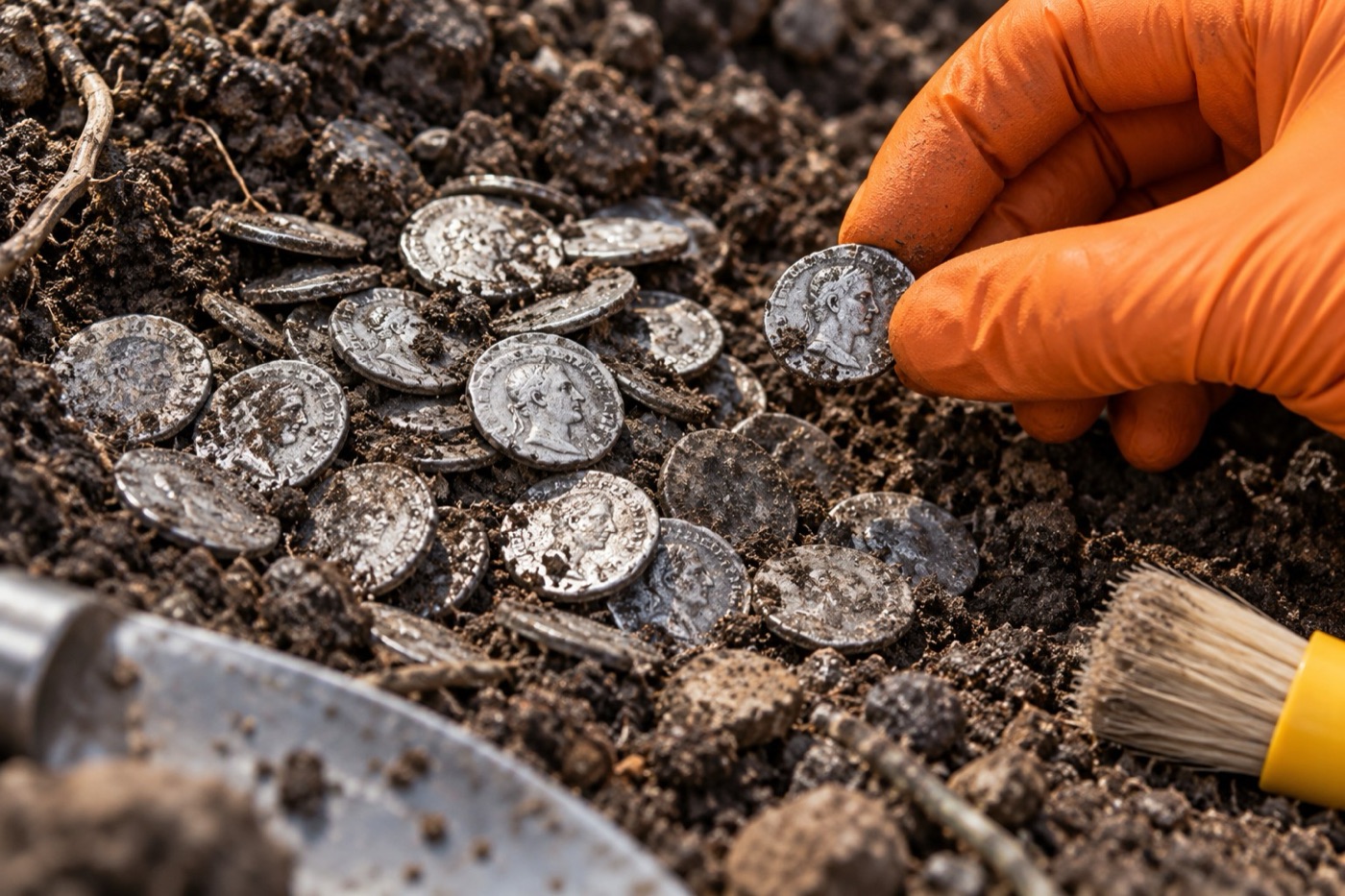
The hoard holds 934 denarii, the oldest struck in 148 BC. It is the largest find from Hadrian's period yet recorded in Germany.
Before you read
1Warm up3 questions
Talk about these questions with a partner.
- What would you do first if you found a pot of old coins?
- Would you rather find one rare object or hundreds of ordinary ones?
- What makes buried treasure exciting beyond the money?
2Key words8 words
These words are in the article. Choose the letter of the meaning for each one.
- archaeologists
- remarkable
- century
- emperor
- savings
- mystery
- electronic
- record
- Apeople who study the past by digging up old things
- Ba period of one hundred years
- Cthe male ruler of a very large country
- Dmoney that you keep and do not spend
- Every unusual and worth noticing
- Fto write down information so you can use it later
- Gsomething that nobody can explain
- Hworking with electricity, like a phone or a computer
1Warm up3 questions
Talk about these questions with a partner.
- What would you do first if you found a pot of old coins?
- Would you rather find one rare object or hundreds of ordinary ones?
- What makes buried treasure exciting beyond the money?
2Key words8 words
These words are in the article. Choose the letter of the meaning for each one.
- hoard
- specialists
- republic
- fortune
- container
- evidence
- trader
- expenses
- Aa very large amount of money
- Ba secret store of valuable things
- Cpeople who know a great deal about one subject
- Da country with no king or emperor
- Efacts or signs that help show what is true
- Fa person who buys and sells goods
- Gsomething, such as a pot or box, that holds other things
- Hmoney that you have to spend on things like travel or food
1Warm up3 questions
Talk about these questions with a partner.
- What would you do first if you found a pot of old coins?
- Would you rather find one rare object or hundreds of ordinary ones?
- What makes buried treasure exciting beyond the money?
2Key words8 words
These words are in the article. Choose the letter of the meaning for each one.
- specimen
- vessel
- excavation
- plausible
- legionary
- circulation
- displacement
- deposit
- Aa soldier in the ancient Roman army
- Bthe movement of money from one person to another
- Cone example of something, taken to show what the others are like
- Da container for liquid, such as a jar or bowl
- Ean amount of something left or placed in one spot
- Fbeing forced to leave your home or land
- Gthe careful digging of the ground to find old things
- Hseeming likely to be true
Read
3Read the article
The paragraphs are numbered. Look out for the key words from task 2.
Core version
Oliver Riedl was searching a field near Wesseling, in western Germany, when his metal detector went off. He found a Roman silver coin, then another. The machine kept signalling, and he realised there was probably something important under the ground. He contacted local archaeology experts instead of trying to remove everything himself. What they found was one of the most remarkable Roman discoveries in Germany in recent years.
The search began in October 2025, but the full discovery was announced publicly in September 2026. Archaeologists eventually recovered 934 Roman silver coins. Each one is called a denarius, and the plural is denarii. Together they weighed about 3.1 kilograms. Some were more than 2,000 years old, while the newest dated from around AD 124 or 125, during the time of the Roman emperor Hadrian.
The coins had probably been buried in the second century AD, possibly inside a pot. Nobody knows who put them there. The owner might have wanted to keep their money safe during a dangerous period, or perhaps they were saving for something important. What is certain is that the money was never collected, and it stayed underground for nearly nineteen centuries.
The number of coins was extraordinary. Experts estimated that an ordinary Roman soldier could have needed years to put aside a similar amount. People in Roman times had different ways of keeping money, but they did not have modern bank accounts or electronic payments. Hiding valuable coins could be a sensible decision, even though it came with the risk of forgetting the location or never returning.
Riedl's behaviour was also important. He was carrying out a permitted search and informed the authorities when he realised what he might have discovered. Archaeologists could then study the place properly and record how the coins were buried. That information may help researchers understand who owned them and what was happening in the area at the time. A coin removed without recording its location can lose part of its historical value.
The collection went on display at the LVR State Museum in Bonn in September 2026. Visitors can now see money that somebody held, saved and eventually hid almost 1,900 years ago. The mystery of its owner may never be solved. But the story reminds us that history is not only about emperors, battles and famous buildings. Sometimes it is about an ordinary person who buried their savings and never came back.
Intermediate version
Oliver Riedl, an amateur archaeologist carrying out an authorised search, was working a field near Wesseling, south of Cologne, when his metal detector kept signalling. It led him to several Roman silver pieces, and he contacted specialists. The first coins were found in October 2025. Specialists then recovered a hoard of 934 denarii weighing 3.1 kilograms, and the find was announced publicly in September 2026.
The collection contains coins from several periods of Roman history. The oldest dates from 148 BC, when Rome was still a republic, and the most recent was produced around AD 124 or 125 under the emperor Hadrian. Archaeologists believe the money was deliberately buried soon afterwards, probably inside a container that did not survive intact. It is the largest hoard from Hadrian's period found in Germany, according to the regional archaeological authorities.
Who would have owned such a fortune? That remains a mystery. The money might have belonged to a wealthy individual, a trader or someone saving for an important purchase. Archaeologists have suggested that it could have been hidden for safety during uncertain times. Whatever the reason, something prevented the owner from collecting it. Perhaps they died, moved away or simply lost access to the place where the coins were buried.
The amount was considerable. Experts have compared it with the earnings of a Roman soldier, suggesting that it represented several years of savings after expenses. Although coins are familiar objects, their value in the ancient world is difficult to compare directly with modern money. What makes this collection unusual is not simply its weight but the number of coins stored together and the long period of history they represent.
Riedl's decision to inform the authorities mattered almost as much as the discovery itself. By investigating the area carefully, archaeologists could record the coins' position and examine traces of the original container. Such details provide clues about how and why the money was hidden. When historical objects are dug up without proper records, much of their story can disappear, even if the objects themselves survive.
The coins have since been displayed at the LVR State Museum in Bonn, where visitors can inspect a fortune that lay hidden for nearly 1,900 years. The find gives historians another small piece of evidence about Roman life in what is now western Germany. It also leaves room for a more human question: what plans did the owner have for all that money? We may never know, but the fact that nobody returned to collect it is what makes the treasure so intriguing.
Advanced version
Oliver Riedl's metal detector kept sounding in a field near Wesseling in western Germany. He found Roman silver coins and alerted the regional authorities. Their investigation uncovered 934 denarii weighing about 3.1 kilograms. Found in October 2025 and announced in September 2026, the hoard is described as Germany's largest known from the reign of Hadrian.
The coins offer a compressed history of Roman power. The oldest specimen dates to 148 BC, when the republic still governed Rome, while the youngest was struck in AD 124 or 125, during Hadrian's reign. Most belong to the intervening imperial period. Archaeologists believe the collection was deliberately concealed in the second quarter of the second century AD, probably inside a vessel whose traces were examined during excavation. The hoard survived beneath ordinary farmland for almost nineteen centuries, outlasting the political system that gave the coins their value.
Its original purpose is much harder to establish. Money may have been buried to protect it from theft, disorder or simple misfortune, particularly in a world without the conveniences of modern banking. But an attractive explanation is not necessarily a demonstrated one. The owner's identity is unknown, as are the circumstances that prevented retrieval. Death, displacement and forgotten locations all remain plausible possibilities, and it is unlikely that the coins alone will ever clear up the mystery.
The scale of the deposit is nevertheless revealing. Regional specialists have compared it with the income of a Roman legionary, suggesting that accumulating a similar quantity of silver could have required years of saving. Such comparisons are necessarily approximate, but they help get across that this was not loose change. The coins also reveal the long circulation of money: pieces produced generations apart could remain in use together, carrying portraits and symbols from different phases of Roman history into the hands of later owners.
Of equal significance is the way the discovery was handled. Riedl was searching with permission and notified professionals as soon as he recognised the potential importance of his find. Archaeology depends on context as well as objects. The position of a hoard, the surrounding soil and the remains of its container may answer questions that isolated coins cannot. An impressive collection acquired without documentation can quickly become little more than a display of valuable metal; this one retained evidence about the act of concealment itself.
Now exhibited at the LVR State Museum in Bonn, the denarii are both public treasure and private mystery. Visitors can study portraits of rulers and the changing imagery of Roman authority, but the most absorbing figure is absent from every coin. Somebody accumulated the money, judged the ground a safe place to hide it and expected, presumably, to return. Almost 1,900 years later, the coins have come to light. The person who put them there remains beyond the reach of the metal detector, and perhaps of history itself.
After you read
4True, false or not given5 statements
Choose T (true), F (false) or NG (the article does not say).
- Riedl contacted local archaeology experts.
The text says: "He contacted local archaeology experts instead of trying to remove everything himself."
- Experts know who buried the coins.
The text says: "Nobody knows who put them there."
- Riedl received a reward for the discovery.
The text does not say whether Riedl received a reward.
- All 934 coins were made in the time of the emperor Hadrian.
The text says some coins were "more than 2,000 years old", and only the newest dated from Hadrian's time.
- A Roman soldier would probably have needed many years to save this much money.
The text says a soldier "could have needed years to put aside a similar amount".
5Vocabulary5 gaps
Complete the sentences with words from the box. Two words are not needed.
certainestimatedextraordinaryinformedpermittedrecoveredweighed
- Divers a lost ring from the bottom of the lake.
- Metal detecting is only allowed in places where it is .
- The shop the police as soon as it saw the broken window.
- Finding a whole pot of coins would be an piece of luck.
- I am that I locked the door, because I checked it twice.
6Verb forms5 gaps
Write the correct form of the verb in brackets.
- Oliver Riedl a Roman silver coin in the field. (FIND)
- The full discovery publicly in September 2026. (ANNOUNCE)
- The coins about 3.1 kilograms together. (WEIGH)
- Somebody the coins almost 1,900 years ago. (HIDE)
- The machine signalling, so Riedl knew there was more. (KEEP)
7Language focuscollocations
Complete the sentences with words from the box. Two words are not needed. A collocation is a pair of words that sound natural together, like make a decision or heavy rain. Learn the pair, not just the word.
displaykeepmakepayrisksolvetake
- Experts hope to the mystery of who owned the coins.
- If you hide money in a field, you take a big .
- The museum will put the coins on for visitors.
- A bank helps people their money safe.
- It is sensible to care when you handle old coins.
4True, false or not given5 statements
Choose T (true), F (false) or NG (the article does not say).
- All the coins in the hoard were produced under the emperor Hadrian.
The text says the oldest dates from 148 BC, when Rome was still a republic.
- The newest coin was made more than two centuries after the oldest.
The oldest dates from 148 BC and the newest from around AD 124 or 125.
- Riedl was paid by the museum for the hoard.
The text does not mention any payment to Riedl.
- Archaeologists found the original container in perfect condition.
The text says the container "did not survive intact".
- Archaeologists could record the position of the coins because they investigated the area carefully.
The text says: "By investigating the area carefully, archaeologists could record the coins' position".
5Vocabulary6 gaps
Complete the sentences with words from the box. Two words are not needed.
authorisedconsiderableintactpurchaserelicstokenstraceswealthy
- Only staff are allowed to enter the vault.
- Remarkably, the vase survived the earthquake , without a single crack.
- Restoring the old bridge will need a amount of money.
- The detective found of mud on the floor, so he knew someone had come in recently.
- Only a very family could afford a house like that.
- He saved for months before making the of a new car.
6Verb forms5 gaps
Write the correct form of the verb in brackets.
- The first coins in October 2025. (FIND)
- By the time the find was announced, specialists the hoard for several months. (EXAMINE)
- If the owner had returned, the coins underground for nineteen centuries. (NOT STAY)
- Anyone who finds a hoard the authorities. (SHOULD, TELL)
- Riedl decided the authorities rather than keep quiet. (INFORM)
7Language focuscollocations
Complete the sentences with words from the box. Two words are not needed. Many B2 collocations pair a verb with an abstract noun. Notice which verb goes with which noun, because a similar verb is often wrong.
drawobligedpieceplaceraisesshedtake
- The hoard may light on trade across the Roman empire.
- Historians should avoid trying to firm conclusions from a single find.
- The hoard more questions than it answers.
- In many countries, finders are legally to report discoveries of this kind.
- A single of evidence is rarely enough to settle a historical question.
4True, false or not given5 statements
Choose T (true), F (false) or NG (the article does not say).
- The hoard contains coins made under more than one system of government.
The oldest dates from when "the republic still governed Rome", the youngest from Hadrian's reign.
- Archaeologists have established why the coins were buried.
The text says the original purpose is "much harder to establish" and an attractive explanation is not a demonstrated one.
- The vessel that held the coins was made of pottery.
The text mentions a vessel but never says what it was made of.
- The political system that gave the coins their value had ended long before they were found.
The text says the hoard "outlasted the political system that gave the coins their value".
- Specialists describe the comparison with a legionary's income as exact.
The text says such comparisons are "necessarily approximate".
5Vocabulary6 gaps
Complete the sentences with words from the box. Two words are not needed.
accumulatingapproximateconcealeddiscloseddocumentationinterveningreclaimedretrieval
- The smugglers the stolen manuscripts behind a false wall for decades.
- In the years between the two wars, the town changed beyond recognition.
- Despite repeated attempts, the of the lost files proved impossible.
- She spent decades a collection of rare maps.
- The architect gave an cost, warning that the final bill might differ.
- Without proper , the sale of the painting could not be verified.
6Word forms5 gaps
Use the word in brackets to make a word that fits the gap.
- Archaeologists were struck by the sheer of the find. (SIGNIFY)
- Without a written record, any claim about the owner's motives remains pure . (SPECULATE)
- It would be to claim that one hoard explains how all Romans saved money. (WISE)
- Such comparisons with a soldier's income are, by their nature, . (PRECISE)
- The owner's to return left the question of ownership unanswered. (FAIL)
7Language focuscollocations
Complete the sentences with words from the box. Two words are not needed. At C1, adjective plus noun pairs carry precise meaning. Choose the adjective that a writer would naturally use, not just one that fits the sense.
idleornatescantsheerstarktantalisingtentative
- The coins offer a glimpse of how money moved around the Roman world, but they leave most questions open.
- Given how the surviving evidence is, any claim about the owner's motives is conjecture.
- The loss of the owner's name is a reminder that most lives leave no record.
- Historians have so far offered only explanations for the burial.
- The scale of the hoard is what makes it so unusual.
Speak
8Talk about it3 questions
Discuss in pairs or small groups. Give reasons for your answers.
- Should a finder get to keep something that matters to a place's history?
- What can ordinary objects tell us that grand buildings cannot?
- Which object from your life would help a future historian understand today?
9Role-play: what should we do with the old coins?
Work in pairs. Read your card, then have the conversation. Swap roles and do it again.
Student A · the neighbour who found the pot
While digging a flower bed by the shared wall, you found an old pot of coins. You'd like to sell them and share the money. Explain why, and answer your neighbour's worries.
Student B · the other neighbour
You think the coins may be important to the history of your town. You want to tell the local museum. Ask questions, then try to agree on a plan.
Useful phrases
- I'd like to find out what they're worth.
- We shouldn't sell them before an expert has looked.
- They might tell us something about the past.
- That's a fair point, but it's our garden.
- What if we told the museum first?
- Let's agree on a plan we're both happy with.
Afterwards, tell the class what you agreed and whether you both felt it was fair.
Your words
Highlights0 saved
Highlights0 saved
Highlights0 saved
Was this lesson useful? Support johnplusnews on Ko-fi
Continue reading
Food
The Chef Who Lost His Job Over Pineapple
An Italian chef in Australia was sacked for refusing to add pineapple. A food historian says the rule he was defending is younger than he thinks.
History
Were People Getting High 2,800 Years Ago?
Cannabis seeds and chemical traces in preserved hair from a Siberian tomb suggest that some Scythians were exposed to its intoxicating compounds about 2,800 years ago. The evidence is strong, but it leaves many questions open.
Culture
Why Young People Are Turning Up to Ceilidhs
An old Scottish and Irish dance is filling pubs with people in their twenties. Ticket sales are up, and nobody has to arrive with friends.