News lesson6 October 2026
The Ancient Sculptures Dividing Athens and London
The Parthenon sculptures have been in London since the 1800s. Greece says it is time they went back, and Britain is still deciding.
Before you read
1Warm up3 questions
Talk about these questions with a partner.
- Would you rather see an ancient object where it was made or in a big world museum?
- What gives an object a sense of belonging to a place?
- Would a perfect copy offer the same museum experience?
2Key words8 words
These words are in the article. Choose the letter of the meaning for each one.
- sculptures
- temple
- empire
- surviving
- legally
- argues
- ruled
- debate
- Ain a way that the law allows
- Bstatues and other art made by carving stone or wood
- Ca discussion where people give different opinions
- Da group of countries ruled by one powerful government
- Estill existing after a long time
- Fcontrolled a country as its leader or government
- Ggives reasons to show that something is true
- Ha building where people pray or worship
1Warm up3 questions
Talk about these questions with a partner.
- Would you rather see an ancient object where it was made or in a big world museum?
- What gives an object a sense of belonging to a place?
- Would a perfect copy offer the same museum experience?
2Key words8 words
These words are in the article. Choose the letter of the meaning for each one.
- remarkable
- trustees
- civilisations
- partnership
- colonial
- injustices
- monument
- identity
- Aconnected with one country ruling another
- Bunusual and worth noticing
- Can agreement to work together
- Da large building or statue from the past
- Ewhat makes a person or a country special
- Fa group of people who look after an organisation
- Gunfair things that happen to people
- Hlarge groups of people with their own culture and history
1Warm up3 questions
Talk about these questions with a partner.
- Would you rather see an ancient object where it was made or in a big world museum?
- What gives an object a sense of belonging to a place?
- Would a perfect copy offer the same museum experience?
2Key words8 words
These words are in the article. Choose the letter of the meaning for each one.
- celebrated
- authorisation
- heritage
- artefacts
- reunification
- disposal
- occupation
- neutral
- Athe control of a country by foreign soldiers
- Bfamous and admired by many people
- Cobjects made by people in the past, often found in museums
- Dthe act of bringing separated parts together again
- Eofficial permission to do something
- Fthe history and traditions of a country that are passed down
- Gnot supporting either side
- Hthe act of getting rid of something or giving it to someone else
Read
3Read the article
The paragraphs are numbered. Look out for the key words from task 2.
Core version
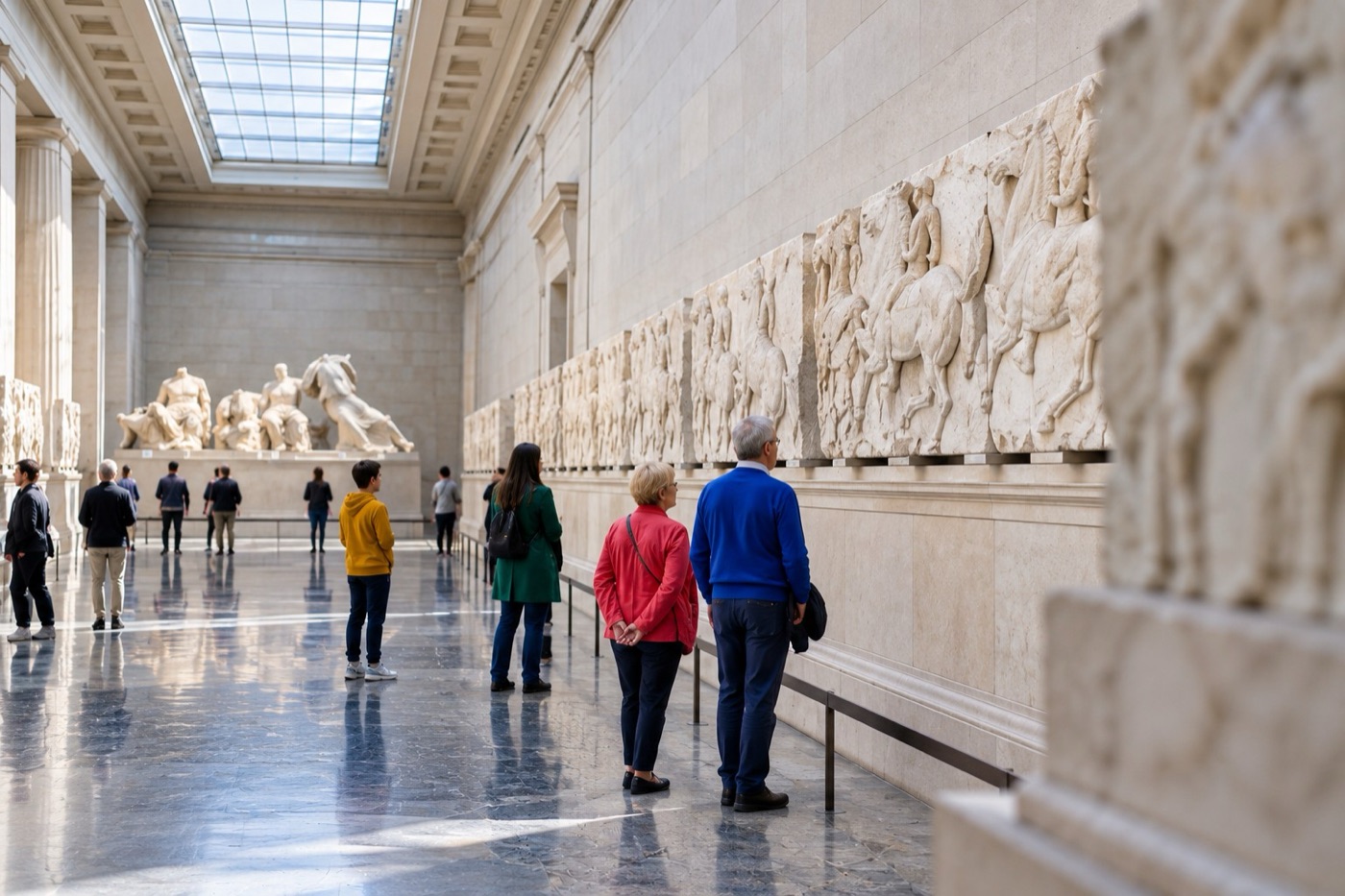
Inside the British Museum in London, visitors can see ancient marble sculptures that once decorated the Parthenon, a famous temple in Athens. The sculptures are more than 2,000 years old. They are often called the Elgin Marbles, after the British diplomat who took them to Britain in the early 1800s. For many years, Greece has asked for them to be returned.
When the sculptures were removed, Greece was controlled by the Ottoman Empire. Lord Elgin said he had permission from Ottoman officials to carry out work at the ancient site, but people still disagree about what he was allowed to take. Several large pieces were moved to Britain, and the British government later bought the collection. The sculptures have been in the British Museum for more than 200 years.
The Greek government believes the pieces belong together with other Parthenon sculptures in Athens. It says they are part of an important ancient building and of Greek cultural history. The Acropolis Museum, near the Parthenon, has space to display them. Greece wants visitors to understand how the surviving pieces originally fitted together.
The British Museum takes a different view. It argues that the sculptures were acquired legally and that displaying them alongside objects from other cultures helps people learn about world history. There is also a British law that normally stops the museum giving away items from its permanent collection. Officials have discussed possible loans or an arrangement in which the sculptures spend time in both countries, but ownership remains a major problem.
This argument is bigger than one museum. Collections around the world contain important objects from countries that were once ruled by foreign powers. Some people believe those objects should return to the places where they were made. Others think large international museums allow more people to see them. The difficulty is deciding what is fair today when the objects changed hands so long ago. Whatever happens, the debate asks an important question: who has the right to tell a country's history?
Intermediate version
Visitors to the British Museum in London can admire a remarkable collection of ancient Greek sculptures. For centuries, these marble figures and decorative panels formed part of the Parthenon, a temple on the Acropolis in Athens. Today they are better known as the Parthenon Marbles, or sometimes the Elgin Marbles. Their beauty is rarely disputed. Who should own and display them is another matter entirely.
The disagreement began more than 200 years ago. In the early 1800s, Greece was under Ottoman rule when Lord Elgin, a British diplomat, arranged for sculptures to be removed from the Acropolis. He maintained that he had permission from Ottoman authorities, though the exact limits of that permission have been debated ever since. The British government bought the collection in 1816, and it became part of the British Museum.
Greece argues that the surviving pieces should be reunited in Athens, close to the building they once decorated. For Greek campaigners, the issue is not simply about where tourists can see valuable works of art. The sculptures are part of the country's history and identity, and removing them from their original setting splits up parts of a single monument. The modern Acropolis Museum was designed with the possibility of displaying them together in mind.
The British Museum argues that displaying objects from different civilisations side by side encourages visitors to make connections across cultures. Its trustees also regard the marbles as legally held. Under legislation passed in 1963, the museum is generally unable to hand over objects from its collection. This makes a permanent return difficult without a change to the law or some other agreement.
Discussions have dragged on for years and have included proposals for a partnership involving loans or the temporary movement of objects between London and Athens. In October 2026, British Museum chairman George Osborne expressed hope that an arrangement could still be reached, suggesting that the sculptures might spend periods in both countries. Such a plan could bring the pieces to Athens, but Greece has resisted any deal that appears to require it to recognise British ownership.
The dispute reflects a much wider question facing major museums. Many collections include objects acquired during wars, colonial rule or periods when local people had little political power. Returning them may help put right historic injustices, while international museums argue that their collections have educational value. There is no solution that satisfies everyone. At the heart of the Parthenon debate is a question about who tells the story of an object.
Advanced version
The Parthenon Marbles are among the British Museum's most celebrated objects, yet their continued presence in London is inseparable from one of the institution's most persistent controversies. Carved for the fifth-century BC temple on the Acropolis, the surviving sculptures are now divided principally between Britain and Greece. Greece wants the surviving pieces reunited in Athens. The museum's trustees point to ownership law and the value of showing objects from different cultures together. Those arguments lead to a simple question with no easy agreement: where do the sculptures belong?
The dispute traces back to the early nineteenth century, when Lord Elgin arranged for sculptures to be removed from the Acropolis under Ottoman rule. He asserted that he had obtained the necessary permission, but historians and campaigners continue to dispute the scope and legitimacy of that authorisation.
In 1816, the British state purchased his collection and placed it in the museum. Its defenders argue that the transaction was lawful by the standards of the period; critics reply that the Greek population had no meaningful control over the decisions being made about its heritage. Successive Greek administrations have pressed for the sculptures' return ever since, and the campaign has never entirely died down.
Greek governments have long maintained that the marbles belong with the remaining architectural sculpture in Athens. The argument is unusually strong because the pieces were not independent artefacts assembled from different locations: they formed an artistic programme associated with one identifiable monument. The Acropolis Museum offers a setting in which the surviving elements could be interpreted together, with the temple itself visible nearby. Reunification, in this view, would restore a context that a divided collection cannot fully provide.
The British Museum counters that its international displays place ancient Greek civilisation in dialogue with other cultures. Trustees also face a significant statutory obstacle. The British Museum Act 1963 severely restricts the disposal of objects from the collection, meaning that a permanent transfer would be legally complicated. Successive discussions have therefore explored partnership arrangements, including reciprocal loans. In October 2026, chairman George Osborne outlined his hope for a rotating arrangement under which sculptures might spend time in both Athens and London.
The practical appeal of such a compromise is clear, but it does not iron out the central disagreement. A loan generally assumes that the lender owns what it is lending, an assumption Greece has been reluctant to accept. The dispute is consequently about language and recognition as much as physical possession. An agreement that appears generous in London could still seem to Athens like a demand to legitimise an earlier removal. Neither side can afford to be seen backing down, which is why one initiative after another has stalled at precisely the same point.
The broader implications extend through museum collections worldwide. Artefacts acquired under empire, unequal treaties or military occupation come under renewed scrutiny, while arguments about universal access retain genuine force. Each case has its own legal and historical circumstances, making sweeping solutions difficult. What the Parthenon debate reveals is that museums are not neutral storehouses of the past. Their collections record decisions about power and possession, and those decisions stay open to challenge.
After you read
4True, false or not given5 statements
Choose T (true), F (false) or NG (the article does not say).
- Lord Elgin came from Britain.
The text calls him "the British diplomat".
- The British Museum can freely give away objects from its permanent collection.
A British law "normally stops" the museum giving away items.
- Lord Elgin had family in Greece.
The text says nothing about his family.
- Officials have talked about the sculptures spending time in both countries.
The text mentions "an arrangement in which the sculptures spend time in both countries".
- The Acropolis Museum has no space for the sculptures.
The text says it "has space to display them".
5Vocabulary5 gaps
Complete the sentences with words from the box. Two words are not needed.
collectioncuratordiplomatloanownershippermissiontreaty
- You need written from the owner before you take photos inside the private gallery.
- She works as a and represents her country in a foreign capital.
- My grandfather has a large of old coins.
- Who has legal of the painting is still unclear after the sale.
- The museum asked the gallery for a short of the painting for its summer show.
6Verb forms5 gaps
Write the correct form of the verb in brackets.
- Lord Elgin several large pieces from Athens to London. (TAKE)
- In the end, the British government the collection. (BUY)
- The museum that the sculptures were acquired legally. (SAY)
- Last week, we to the museum by train. (GO)
- The guide up a photo of the temple to show us. (HOLD)
7Language focusphrasal verbs
Complete the sentences with words from the box. Two words are not needed. A phrasal verb is a verb plus a small word. The small word changes the meaning, so learn the two words together.
breakfindgivegolooksetstand
- Visitors can out more about the temple on the museum's website.
- Greece wants Britain to back the sculptures.
- The museum will up a new room for ancient art.
- I will up the history of the Acropolis before my trip.
- When you finish this room, on to the next one.
4True, false or not given5 statements
Choose T (true), F (false) or NG (the article does not say).
- The Parthenon Marbles are known by more than one name.
The text says they are "better known as the Parthenon Marbles, or sometimes the Elgin Marbles".
- The British Museum received the collection as a gift in 1816.
The text says the British government "bought the collection in 1816".
- Lord Elgin was paid by the Ottoman authorities for his work.
The text does not say anything about payment to him.
- Greece may refuse a deal that seems to accept British ownership.
Greece "has resisted any deal that appears to require it to recognise British ownership".
- The 1963 law makes it simple for the museum to return objects permanently.
The law makes a permanent return "difficult without a change to the law".
5Vocabulary6 gaps
Complete the sentences with words from the box. Two words are not needed.
assembledcampaignersdisputedinspectorslegislationmaintainedresistedreunited
- The family has the old farmhouse carefully for four generations.
- The ownership of the land has been in court for decades.
- New will make it illegal for shops to give out free plastic bags.
- The town council pressure to sell the building to a developer for years.
- The two brothers were finally after twenty years on different continents.
- Environmental gathered outside parliament to demand stronger action on climate change.
6Verb forms5 gaps
Write the correct form of the verb in brackets.
- By the time we reached the gallery, the guide his talk. (FINISH)
- The new gallery by the mayor next spring. (OPEN)
- If I the director of the museum, I would return the sculptures. (BE)
- The curator for the museum since 2015. (WORK)
- She said she the exhibition the following week. (VISIT)
7Language focusphrasal verbs
Complete the sentences with words from the box. Two words are not needed. Some phrasal verbs take an object, and some do not. Check whether the sentence needs a noun after the particle.
breakdrawpullputstandturnwork
- Both sides need time to out the details of the agreement.
- The museum had to off the opening because of the building work.
- The lawyers will up a contract before the meeting.
- The gallery had to down the offer because the law does not allow it.
- Talks could down if neither side is willing to compromise.
4True, false or not given5 statements
Choose T (true), F (false) or NG (the article does not say).
- Greece's hesitation over loans is linked to what a loan would suggest about ownership.
A loan "assumes that the lender owns what it is lending", which Greece has been reluctant to accept.
- The 1963 Act rules out any temporary movement of the sculptures from London.
The Act restricts disposal; the text says discussions have explored "reciprocal loans".
- Critics of the 1816 purchase claim that it broke British law.
Critics are quoted only on Greek lack of control over decisions, not on British law.
- Proposals have repeatedly failed to progress partly because neither side wants to look as if it has given way.
The text says "Neither side can afford to be seen backing down" and proposals stall at the same point.
- The writer treats the Greek case for reunification as weak because the pieces came from several different monuments.
The text says the pieces "formed an artistic programme associated with one identifiable monument".
5Vocabulary6 gaps
Complete the sentences with words from the box. Two words are not needed.
assertedpersistentpretextreciprocalretractedscopestalledstatutory
- The minister that the policy had been approved, although no one could find the paperwork.
- Negotiations have over the question of who should pay for the repairs.
- The two companies signed a agreement: each would share its technology with the other.
- The council has a duty to inspect every restaurant at least once a year.
- Rumours of a merger proved remarkably , resurfacing every time the company denied them.
- The inquiry was criticised for its narrow , which left out the most serious complaints.
6Word forms5 gaps
Use the word in brackets to make a word that fits the gap.
- Lawyers questioned the of the contract, which had never been properly signed. (VALID)
- The report was criticised for its , since it praised the scheme in one chapter and condemned it in the next. (CONSISTENT)
- Historians warn against the of complex events into a single dramatic story. (SIMPLIFY)
- The minister's to discuss the matter publicly only fuelled speculation. (RELUCTANT)
- Critics saw the move as political rather than a principled stand. (EXPEDIENT)
7Language focusphrasal verbs
Complete the sentences with words from the box. Two words are not needed. At this level many phrasal verbs are fixed and figurative. Learn the particle with the verb, and watch the tense or form the sentence needs.
bringbrushheldruledswepttoneturned
- Under pressure, the authors agreed to down their criticism.
- The committee refused to aside the objections of its own members.
- Her defiant speech was up as proof that reform was possible.
- Ministers have not out further talks, though they expect little from them.
- The new law could about changes that few people predicted.
Speak
8Talk about it3 questions
Discuss in pairs or small groups. Give reasons for your answers.
- What would a fair agreement over the sculptures look like?
- Does easy access for visitors settle where an object should stay?
- Who should help tell the story beside an object in a museum?
8Talk about it3 questions
Discuss in pairs or small groups. Give reasons for your answers.
- What would a fair agreement over the sculptures look like?
- Does easy access for visitors settle where an object should stay?
- Who should help tell the story beside an object in a museum?
8Talk about it3 questions
Discuss in pairs or small groups. Give reasons for your answers.
- What would a fair agreement over the sculptures look like?
- Does easy access for visitors settle where an object should stay?
- Who should help tell the story beside an object in a museum?
9Role-play: Grandmother's painting
Work in pairs. Read your card, then have the conversation. Swap roles and do it again.
Student A · the cousin who wants to keep it
You and your cousin have inherited a valuable painting from your grandmother. You want to keep it in the family home, where she hung it. Explain why it matters to you, and listen to your cousin's idea.
Student B · the cousin who wants to lend it
A local museum has asked to show the painting for a year. You think more people should see it. Explain your idea, and try to find an arrangement you can both accept.
Useful phrases
- I'd hate to see it leave the family.
- That's a fair point, but more people could enjoy it.
- What if we lent it for six months?
- I don't think it's right to give it away.
- We'd still own it, wouldn't we?
- Let's try to find a compromise.
Afterwards, tell the class: where did the painting end up, and was it a fair decision?
Your words
Highlights0 saved
Highlights0 saved
Highlights0 saved
Was this lesson useful? Support johnplusnews on Ko-fi
Continue reading
Food
The Chef Who Lost His Job Over Pineapple
An Italian chef in Australia was sacked for refusing to add pineapple. A food historian says the rule he was defending is younger than he thinks.
History
Were People Getting High 2,800 Years Ago?
Cannabis seeds and chemical traces in preserved hair from a Siberian tomb suggest that some Scythians were exposed to its intoxicating compounds about 2,800 years ago. The evidence is strong, but it leaves many questions open.
Culture
Why Young People Are Turning Up to Ceilidhs
An old Scottish and Irish dance is filling pubs with people in their twenties. Ticket sales are up, and nobody has to arrive with friends.